Blast Theory History: From London Club Nights to Location Games
Blast Theory history starts in a London club in 1991 and runs through virtual reality, chases across real city streets and phone calls that cast you as the hero of a film. For more than thirty years the British artists’ group has asked one question: what happens when the audience takes part?
Quick answer
What is Blast Theory known for?
Blast Theory is an artists’ group founded in London in 1991 and now based in Brighton. It began with club-night promenade shows, then moved into virtual reality, location-based games and phone works. Its chase game Can You See Me Now? won the Golden Nica for Interactive Art at Prix Ars Electronica in 2003.
London, 1991: a club that became a play

Its founders were “a group of creative people who worked in the Renoir Cinema in London and went clubbing a lot.” The name comes from BLAST, the Vorticist manifesto that Wyndham Lewis published in 1914.
The first piece, Gunmen Kill Three, was made over the summer of 1991 by Matt Adams, Lorraine Hall, Niki Jewett, Will Kittow and Ju Row Farr, and “first shown at Union Chapel in London in September 1991.” “It was a club, that changed into a promenade performance and then back into a club at the end,” the group recalls, a clear case of promenade staging, where the audience moves. One spectator was “handed a paintball gun and offered the opportunity to fire at two performers.”
Live art in the 1990s

Chemical Wedding was “Commissioned by the ICA in London for the princely sum of £150.” Spectators voted with their feet, moving into coloured pools of light: “Red indicates yes, blue means no.” The venue list says 1992 and the history page 1994, so the early 1990s is the safe date.
Stampede (1994) was “A promenade piece looking at crowds and rioting,” in which “A system of pressure pads allow the audience to trigger recordings.” The technology was simple, but the audience was already setting the work in motion.
Kidnap, 1998
A 1997 residency in Berlin led to Kidnap, which “launched to the press and public on 15 May 1998.” “Each entrant paid a fee of £10,” and “Two winners were then snatched in broad daylight and taken to a secret location where they were held for 48 hours,” streamed live online. The group called it “a drama where you pay for the chance to play the lead role.” Stephen Armstrong of The Sunday Times wrote on 5 July 1998 that “no other performance I have ever seen has brought about such intense extremes of emotion.”
The Nottingham years

In the late 1990s Blast Theory began working with the Mixed Reality Lab at the University of Nottingham, which “creates interactive technologies to enhance everyday life.” The group’s history page gives both 1997 and 1998 for the start. The first joint work was Desert Rain (1999), “a large scale virtual reality game” that was nominated for an Interactive Arts BAFTA in 2000. The partnership has produced “over 45 research papers,” and the group says it is, “to our knowledge,” “the longest and most productive partnership between a university and a group of artists anywhere in the world.”
Blast Theory history in eight works
Each asked something different of its audience.
| Year | Work | What the audience did |
|---|---|---|
| 1991 | Gunmen Kill Three | One spectator was offered a paintball gun |
| Early 1990s | Chemical Wedding | Voted by standing in coloured light |
| 1994 | Stampede | Triggered recordings with pressure pads |
| 1998 | Kidnap | Paid £10 to enter; two winners held 48 hours |
| 1999 | Desert Rain | Played a mission in a virtual world |
| 2001 | Can You See Me Now? | Online players hid from street runners |
| 2010 | A Machine To See With | Played the lead in a heist |
| 2015 | Karen | Talked to a life coach who profiles you |
Can You See Me Now?

First shown in Sheffield in 2001, Can You See Me Now? is, in the group’s words, “one of the first location based games.” “Online players navigate a 3D map of a city-centre game area, whilst Blast Theory runners are on the streets for real,” their positions tracked by satellite. An audio stream from the runners’ walkie-talkies let players hear them “getting lost, cold and out of breath.”
Each player first answered a question: “Is there someone you haven’t seen for a long time that you still think of?” When a runner caught a player, the runner named that person.
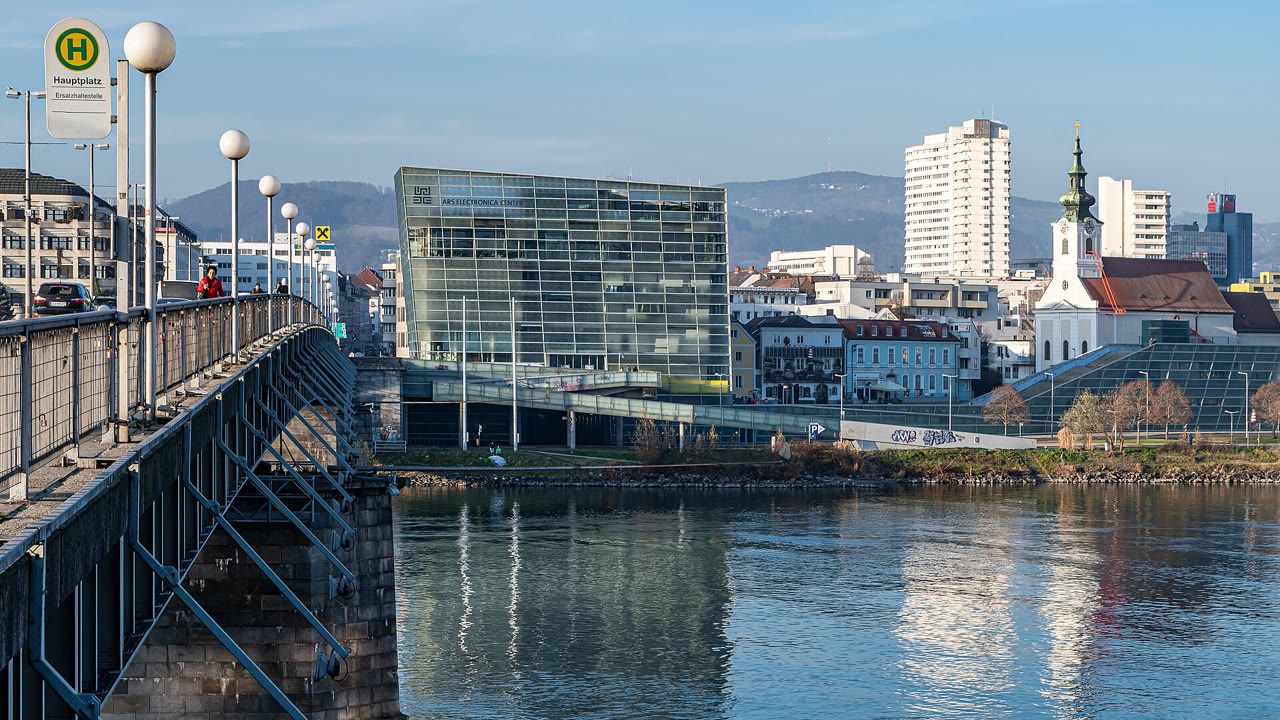
In 2003 the work won the Golden Nica for Interactive Art at Prix Ars Electronica (the statuette pictured is a 2013 award, not Blast Theory’s). Ars Electronica’s archived 2003 page for Can You See Me Now? describes “the interpenetration of real and virtual space, of presence and absence.” With help from 164 Kickstarter backers, the group rebuilt the game for phones in 2024.
The city as a game board
Uncle Roy All Around You opened at the ICA in June 2003, and our post on how Uncle Roy found its players without GPS covers it. I Like Frank (Adelaide, 2004) was billed by the group as “the world’s first mixed reality game for 3G phones.”
Rider Spoke, first shown at the Barbican in October 2007, sent cyclists out alone with a phone on the handlebars; it appears in Rider Spoke and other theatre without actors. A Machine To See With (San Jose, 2010) began with a call: “Just listen to the voice on the phone. The voice tells you what to do.” A recorded voice telling one listener a story is far older than the mobile phone, as the history of the audiobook, from talking books to downloads, shows.
Karen, made with National Theatre Wales from 2013, is a smartphone drama in which a life coach profiles the player. Like games that put players inside a story, these works make the visitor the protagonist.
An American parallel: Antenna’s audients
Antenna Theater, founded in Sausalito in 1980, also cast its audience as the lead and also worked with a university lab. Radio Interference (1987) “was developed as an artist-in-residence project at the Media Lab at the Massachusetts Institute of Technology.” Barbara Masi of The Tech credited an “MIT collaboration directed by Richard Leacock and Glorianna Davenport,” and wrote that “Hardman and Leacock explored how media manipulate people and people manipulate media.”
What Antenna meant by an audient, a word Hardman coined, was a listener on headsets who could “receive entirely separate information” from everyone else. In Big Brother (2007), Antenna gave groups of audients “soundtracks with differing instructions, causing each participant to experience story segments distinctively.”
| Aspect | Antenna Theater (US) | Blast Theory (UK) |
|---|---|---|
| University lab | MIT Media Lab, Radio Interference, 1987 | Mixed Reality Lab, Nottingham, from the late 1990s |
| Audience role | The audient, the main actor | Players, runners, riders |
| Different information per person | Big Brother, 2007 | Rider Spoke recordings left for other riders, 2007 |
Chris Hardman put the idea plainly in 1983: “Each decision or result will determine the next step in your adventure.” No source links the two companies; each reached the audience-as-player on its own. More of Antenna’s experiments are gathered under Walkmanology and Antenna’s other new theater forms.
Blast Theory today
Today the group is led by Matt Adams and Nick Tandavanitj and works from Brighton. It won the 2016 Nam June Paik Art Center Award, and Blast Theory’s own history page lists the full run of works.
Frequently asked questions
When was Blast Theory founded?
In London in 1991. Its first work, Gunmen Kill Three, was first shown at Union Chapel in September 1991.
What was Can You See Me Now?
One of the first location-based games: online players moved through a 3D city while runners chased them on real streets, tracked by satellite. It won the Golden Nica for Interactive Art at Prix Ars Electronica in 2003.
Is Blast Theory theatre or games?
Both. Its early work was live art, and from Desert Rain in 1999 it moved toward games and mixed reality made with the University of Nottingham.