
Somewhere in the Pacific: Snake Theater’s Sunset Play on Fort Cronkhite Beach (1978)
On spring weekends in 1978, an audience sat on the sand at Fort Cronkhite in the Marin Headlands and watched a play end just as the sun went down. Somewhere in the Pacific was a love story about a sailor lost in the war, told with masks, puppets and placards. This is what the audience saw, mostly from Bernard Weiner’s review in the San Francisco Chronicle, and where it sits among Snake Theater’s productions, 1972 to 1980.
Quick answer
What was Somewhere in the Pacific?
Somewhere in the Pacific was a 1978 play by Snake Theater, staged at sunset on the beach at Fort Cronkhite in the Marin Headlands. Masked figures, puppets and a chorus told the story of Ryan, a sailor killed in World War II, and Carole, the woman he left behind. Admission was free.
A beach, a bunker and a war story

Snake’s own history puts it first in the 1978 California Series: “The spring play, SOMEWHERE IN THE PACIFIC, was presented on the beach at Fort Cronkhite, Marin County.” The autumn play moved indoors: 24th Hour Cafe, Snake’s masked truck-stop melodrama.
Robert Hurwitt, writing in 1985, said Snake took Bread and Puppet’s taste for unusual sites “a bit further, all the way out to Fort Cronkhite Beach in the Marin headlands,” for the play that “catapulted the group to local prominence in 1978.” The choice was deliberate: “Hence Fort Cronkhite, studded with World War II-vintage concrete bunkers overlooking the ocean, for a story about a life lost at sea during that war.”
The Golden Gate National Parks Conservancy’s guide to Fort Cronkhite calls it “a former World War II military post that stands at the edge of the Pacific Ocean,” one of the few wartime mobilization posts left in the country. Most sources date the play 1978; one encyclopedia entry on Laura Farabough gives 1977.
5 p.m., seated on the sand

Weiner’s review of March 29, 1978, listed performances on Saturdays and Sundays through April 9, starting at 5 in the afternoon on the beach. “Admission is free. Dress warmly.”
The piece had an “hour-plus running time” and a 21-member ensemble. Eight years later, Esquire remembered it as “a play performed on the beach to hundreds of people.”
| Item | Detail |
|---|---|
| Company | Snake Theater |
| Made by | Laura Farabough and Chris Hardman, with Larry Graber (music) and Evie Lewis (choreography) |
| Masks and puppets | Chris Hardman |
| Ensemble | 21 members |
| Place | The beach at Fort Cronkhite, Marin Headlands |
| Dates | Weekends through April 9, 1978 |
| Time | 5 p.m., ending at sunset |
| Length | Just over an hour |
| Admission | Free (no longer offered) |
Ryan, Carole and the Sharkman

“It is 5:10 p.m.,” Weiner’s review begins. The audience “suddenly notices a young man, dressed in a brown sailor’s uniform, resting motionless in front of a brown rock near the shore.” Someone whispers, “How long has he been standing there?”
The story comes together slowly. “The sailor, it seems, has gone off to the war, having been unable to see Carole before he left.” He talks about the job he was promised, the beach house they could have rented, his Chevrolet parked on the street, and the car keys he left “with a man named David the Shark.”
“The rest of the piece explains the wartime death of Ryan, the sailor, and the devastating emotional impact this had on Carole.” The Sharkman, “a representative of Death,” is hinted to have moved in on her.
Masks, a postman and a giant pencil

Musicians “dressed in ghostly military greys” took their places on a dune platform, chanting what sounded like the word Chevrolet. A giant puppet in a red dress watched from the cliff, one of Snake’s giant puppets. Two figures in “huge masks of General Douglas MacArthur and his wife” sat at a table with a 1940s radio and tea.
Then the chorus switched to “Dear Carole,” a postman buried in the sand raised an arm, and a letter appeared. “A tall, zoot-suity character, carrying a silver shark-case, walks into the picture.” Finally the postman dragged a giant pencil along the beach and the sailor’s words appeared in placards in the furrows: “Suddenly, this theater piece begins to make sense.”
| Moment | What happened |
|---|---|
| Opening | A sailor stands motionless by a rock |
| Chorus | Grey musicians on a dune chant “Chevrolet” |
| The cliff | A giant puppet in a red dress looks out to sea |
| MacArthur | Masked figures drink tea by a 1940s radio |
| The letter | A postman rises from the sand with a letter for Carole |
| The pencil | Placards in the furrows spell out the sailor’s words |
| The film | A shadow-puppet preview of a film called Somewhere in the Pacific |
| The doll’s house | The Sharkman takes Carole’s figurine |
| The waves | MacArthur fights the sea with a kendo stick; three fish dance |
| Sunset | The letter is read again as the sun goes down |
Later images came quickly, including a modified shadow-puppet “sneak preview” of a film (shadow play has a long history of shadow puppetry behind it). The sailor set figurines of himself and Carole in a doll’s house, and the Sharkman took hers away. Sailors drilled on the cliffs.
Timed to the sunset

The ending used the sky. Weiner wrote that “the letter is read again, with its closing lines about the sun going down coming at just about the time the sun does go down.” The company’s own one-line description, on a videotape sketch of the piece, called it a panoramic conceptualization of a love letter read to the sea at sunset.
Weiner stopped himself there: “Well, enough description. I can’t do the poetic nature of the piece justice, in any case.”
What the critic liked, and didn’t
Weiner called it “a unique play, brilliantly staged,” but he had reservations, chiefly “with the pacing and overuse of reiteration of themes.” He compared its manner to “Hospital,” staged by the Magic Theater the year before, and noted that the same team had made Snake’s Dead Play, videotaped in November 1977.
The credits are told in our post on how Snake’s four directors devised the piece, with Hardman designing the masks and puppets. American Theatre’s portrait of Bernard Weiner, the Chronicle’s theatre critic, describes a critic who championed experimental work in unusual venues.
The beach Antenna came back to
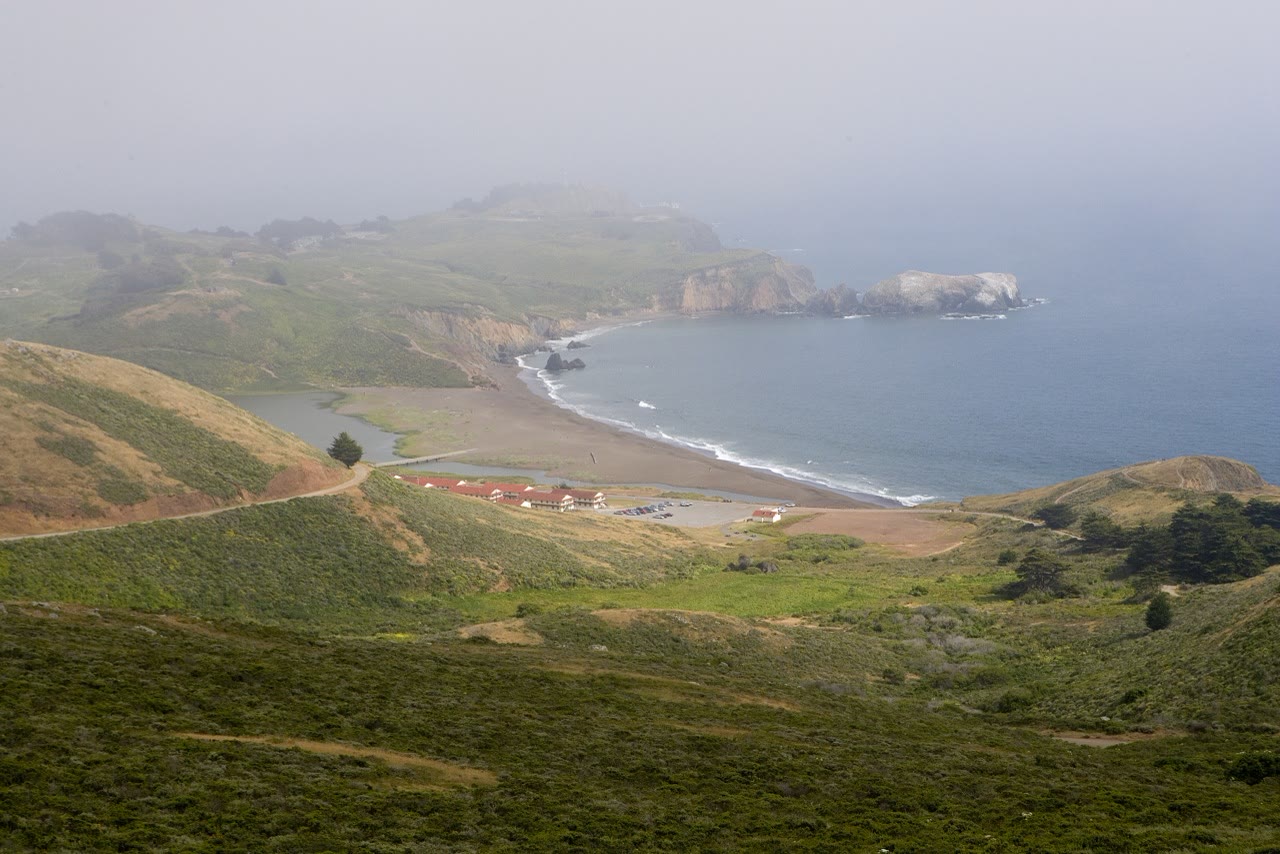
Esquire’s 1986 summary was a list: “a colossal doll, Douglas MacArthur, a setting sun, and words in the sand.” By then Hardman was running Antenna Theater, and the company kept returning to the headlands, with an address at Fort Cronkhite itself by 2000.
In 1992 came Antenna’s 1992 return to the beach, and from 1998 Sands of Time on Rodeo Beach. For the context, see the 1970s San Francisco scene around Snake.
Frequently asked questions
What was the play about?
A sailor, Ryan, who went to war without seeing Carole, died there, and left her to the Sharkman, a representative of Death.
Why Fort Cronkhite?
Its World War II concrete bunkers above the ocean suited a story about a life lost at sea during that war, as Robert Hurwitt put it.
Did it cost anything?
No. The Chronicle listed weekend performances at 5 p.m. with free admission, and advised the audience to dress warmly.
Was it 1977 or 1978?
Antenna’s archive, Hurwitt and Weiner’s March 1978 review all say 1978. One encyclopedia entry on Laura Farabough gives 1977.