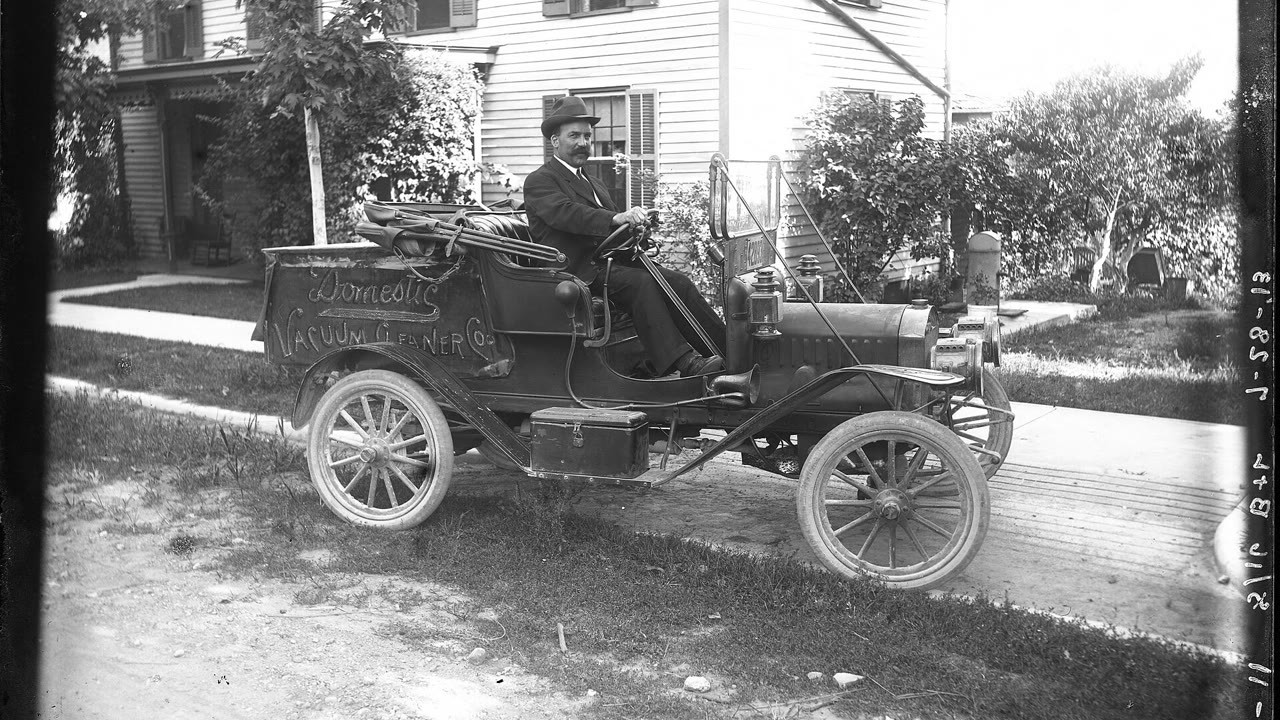
Vacuum: The Play That Launched Antenna Theater (1981-1982)
Before the Walkman mazes, Antenna Theater made a stage play about a vacuum cleaner salesman. Vacuum, which the company calls its first production, was built from hundreds of questionnaires and taped interviews, played by masked performers, and premiered on the Sausalito waterfront in April 1981. Two local reviews from that week describe it in detail.
Quick answer
What was Antenna Theater’s first production?
According to the company, Antenna Theater’s first production was Vacuum, a stage play that premiered in Sausalito in April 1981. Chris Hardman built it from hundreds of questionnaires and taped interviews with vacuum salesmen and housewives, staged with masked performers. It went on to the Performing Garage in New York and a 1982 European tour.
Receive, transform, transmit: building a play from questionnaires
Bernard Weiner of the San Francisco Chronicle explained the method in his review of April 21, 1981. Antenna, he wrote, was designed to “receive, transform and transmit.” It “solicited hundreds of responses from housewives, salesmen and other ordinary citizens about their experiences with vacuum cleaners. Hardman then used the written answers, and on-tape interviews, as a complement to his script outline.”
Hardman told it the same way on Antenna’s page on its new theater forms: “for Vacuum we interviewed a multitude of vacuum cleaner salesmen and housewives and then cut their voices into the tape we used for the performance.” The interviewees, he said, became co-collaborators.
Weiner thought the real voices were the play’s strength: “When we hear salesmen on tape talking about their selling techniques and how they hype themselves up before knocking on doors, we are infinitely more affected than if the same words had been spoken by trained actors.”
Peter Magnant of the Mill Valley Record found the research on display: “One long wall in the lobby is plastered with raw research data, a flurry of questionnaires filled out with people’s answers to some oddly banal queries about their experiences with vacuum cleaners.” The ticket was “an oversized red, white, and blue merchandise tag” reading America Trusts Hoover, “a reference to the vacuum dealer, not the former President.”
Walter and Mary: the story
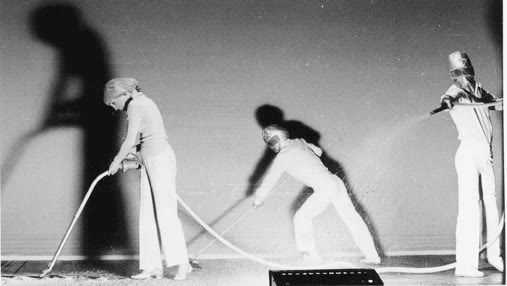
Antenna’s chronology calls Vacuum “A blend of dance, performance sculpture, taped narrative and original music,” a stage play that was “an inside look into the life of a man who sells emptiness.” Weiner described an “hour-long play” with two people at its center.
One was “a nervous cleaner salesman from first rejection to heady success and back to confusion and self-doubt.” The other was “a lonely, alienated housewife, who is able to relate to people mainly when they are trying to sell her something.” The salesman, Walter, was played by Ernesto Sanchez, and the housewife, Mary, by Michele Larsson.
The play did not stay comic. Its ending, Weiner noted, “does lead to a powerful abortion sequence using another kind of cleaner a vacuum extractor.”
Masks, ladders and a vacuum that draws lines
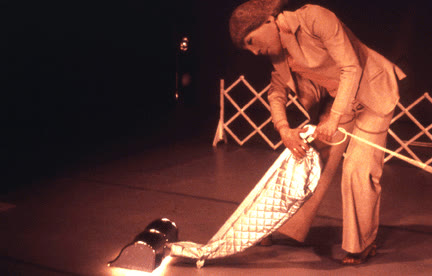
Hardman made full-face latex masks for the performers, and the stage was full of moving objects. Weiner listed them one by one, and the table sets them out.
| Stage device | What it did | Source |
|---|---|---|
| Boards | “suddenly become door frames” | Chronicle |
| Spray painted faces | “climb a ladder of success” | Chronicle |
| A miniature home | “seems to grow from the housewife’s head” | Chronicle |
| A vacuum cleaner | “lays white tracks as it moves across the floor” | Chronicle |
| Padded arrow sculptures | Indicate conversation | Chronicle |
| Full-face latex masks | Made by Hardman | Chronicle |
| The lobby wall | Questionnaires on display | Mill Valley Record |
Two silent performers, Martin Bates and Chris Tellis, moved the props. Vacuum kept its audience still, unlike the later Antenna pieces that moved people through the space in the manner of environmental theater, where audience and action share one space.
Who made it
Both 1981 reviews named the full company. The credits below are as printed and are not extended.
| Role | Name | Source |
|---|---|---|
| Conceived, directed, masks and visuals | Chris Hardman | Mill Valley Record |
| Music and vocal-tape score | Alfred Agius-Sinerco | Chronicle; Mill Valley Record |
| Lighting | Jeremy Rose | Chronicle; Mill Valley Record |
| Costumes | Gail Spaien | Mill Valley Record |
| Mary, and an older housewife | Michele Larsson | Chronicle |
| Walter | Ernesto Sanchez | Chronicle |
| Silent prop movers | Martin Bates, Chris Tellis | Chronicle; Mill Valley Record |
Opening night on the Sausalito waterfront

Vacuum premiered over the weekend before Weiner’s April 21 review. Magnant placed it at “the Pacific Micro System warehouse on the Sausalito waterfront,” while Antenna’s chronology lists the Red Barn in Sausalito. They may be one building or two runs, so the safest statement is that Vacuum premiered on the Sausalito waterfront in April 1981 (the company lists the Red Barn).
The company’s own pages begin the story a little earlier: “It was 1980 and Antenna Theater had just produced its first show called Vacuum.” Read together, the play was made in 1980 and 1981 and opened in April 1981.
Magnant described Antenna as “one of two divisions formed from Sausalito’s renowned Snake Theatre,” the company covered in Snake Theater’s productions of the 1970s. The review also lists the sponsors thanked, among them Vacuums Unlimited and the Mill Valley Lumber Company.
What the critics said about Antenna Theater’s Vacuum

Weiner called Vacuum “extraordinary both as a theater piece about the symbolic meaning of vacuum cleaners in our lives, and in the ingenious way by which the play was constructed.” The company later quoted his line that it was “a must-see for anyone at all interested in the state-of-the-art of experimental theater.” He had doubts too: the script “at times seems somewhat muddy,” and “A choreographer might help here.”
Magnant was won over by an “absolutely riveting performance” and “a remarkably tasty slice of the American pie, completely ritualized.” He added that “everybody in the opening night audience knew when it was over.”
Three years later Artweek, reviewing Amnesia, Antenna’s 1984 Walkman clinic, said its collage method had been “successfully developed in Antenna’s static-audience piece Vacuum (1981).” The company also quotes the New York Times calling Vacuum “a social comedy of a very high order,” with no date or writer given, on Antenna’s board and staff timeline.
New York, Europe, and a Walkman on the plane
Antenna’s chronology takes Vacuum to the Herbst Theater in San Francisco in 1981 and the Performing Garage in New York in 1982. It then “Toured five cities in France, Germany, and the Netherlands.” The cities are not named in any source found.
| Date | Venue | Source |
|---|---|---|
| April 1981 | Pacific Micro System warehouse, Sausalito waterfront | Mill Valley Record |
| 1981 | Red Barn, Sausalito | Antenna chronology |
| 1981 | Herbst Theater, San Francisco | Antenna chronology |
| 1982 | Performing Garage, New York | Antenna chronology |
| 1982 | Five cities in France, Germany and the Netherlands | Antenna chronology |
That trip changed the company. In the Sausalito Historical Society’s 2017 column on Chris Hardman, he recalled: “I was in Europe at the time, it was 1982.” On a flight during the tour, by his account, a new Walkman began playing “The Ride of the Valkyries” as the plane lifted off; the rest is told in how the audient was born and our headphone theater history.
Frequently asked questions
What was Vacuum about?
A door-to-door vacuum salesman and a lonely housewife, told through masked performers and taped interviews with real salesmen and housewives.
How long was Vacuum?
About an hour, according to the San Francisco Chronicle’s 1981 review.
Where did Vacuum tour?
The Herbst Theater in San Francisco, the Performing Garage in New York, and five cities in France, Germany and the Netherlands, according to the company chronology.
Who wrote the music for Vacuum?
Alfred Agius-Sinerco wrote the music and vocal-tape score, according to both 1981 reviews.
Vacuum opens Antenna Theater’s full production chronology, which runs from this stage play to four decades of walk-through work.