The History of Automata: From Hero’s Theatre to Maillardet’s Writing Boy
The history of automata is, from the start, a history of shows. The oldest designs that survive in writing are miniature theatres, and the famous machines of the 18th century toured like performers, with showmen to sell them. This guide follows six of them, citing the museums and libraries that study or hold them today.
Quick answer
What are the most famous automata in history?
Hero of Alexandria described self-powered automata in the first century CE, and al-Jazari’s book of ingenious devices followed in 1206. The 18th century built the celebrated ones: Vaucanson’s duck in Paris in the late 1730s, the three Jaquet-Droz automata between 1768 and 1774, and Henri Maillardet’s writing boy around 1800.
Alexandria: a theatre with no actors

Hero worked in Alexandria in the first century CE or a little later. A University of Glasgow research project explains that “Hero’s treatise purports to give instructions on the creation of two types of self-powered automaton”: one mobile, which “displays a limited narrative,” and one stationary, which “presents a more extended narrative.” “Both present displays within an architectural frame and are powered by a falling weight.”
Both, the project adds, “are inspired in architectural and narrative terms by Greek theatre.” A modern reconstruction at the Kotsanas Museum of Ancient Greek Technology plays the myth of Nauplius in five scenes, from shipbuilders at work, with tool sounds “as if they were real,” to a shipwreck in which “the sound of thunder is heard.” It was theater without actors, long before anyone used the phrase.
Al-Jazari’s Book of Knowledge (1206)
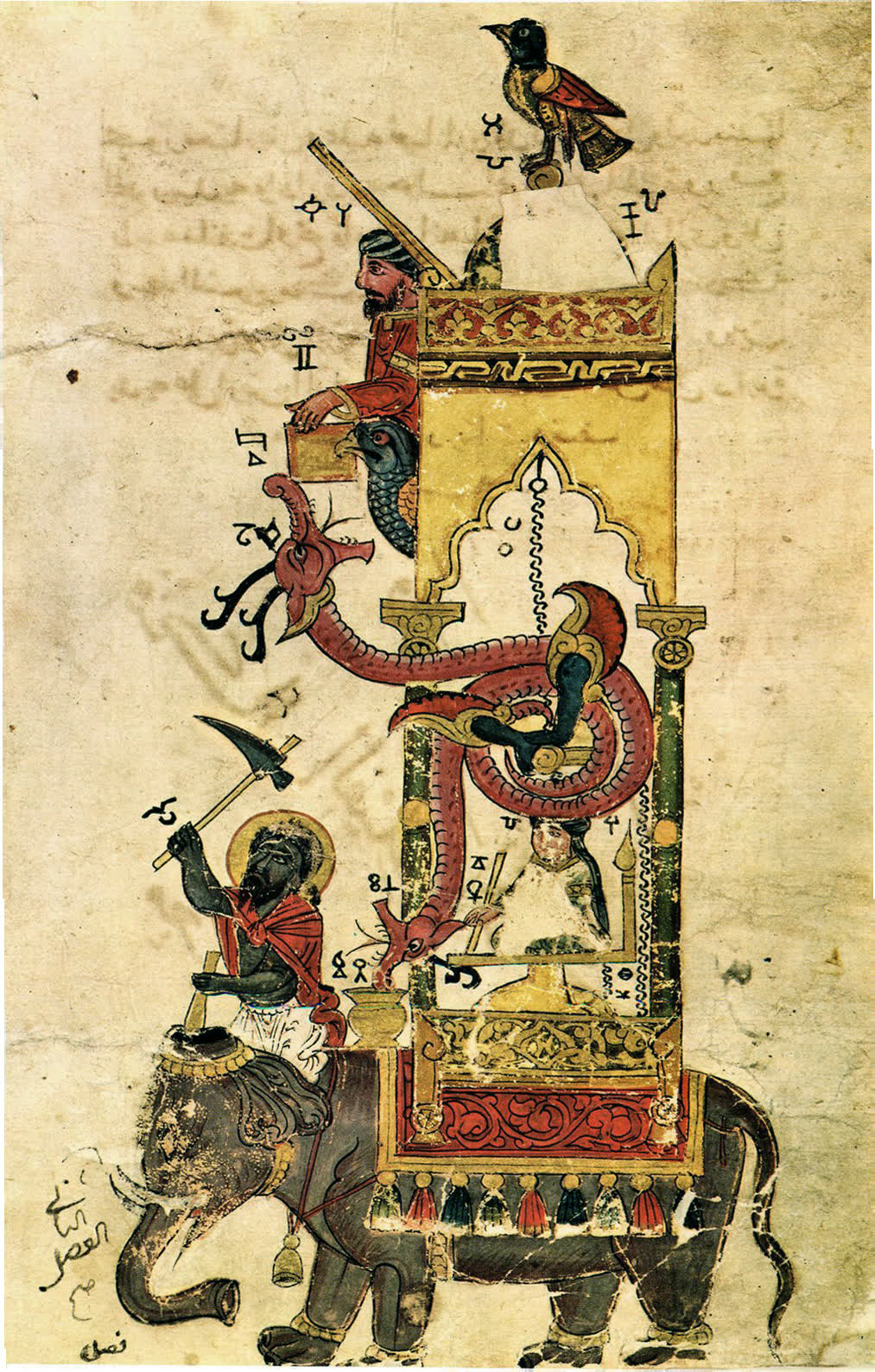
Al-Jazari “was born in 1136 in Diyarbakır” and “served as an engineer in the service of the regional rulers, the Artuqids,” National Geographic reports; over his career he “designed more than a hundred ingenious devices.” In 1206 he produced The Book of Knowledge of Ingenious Mechanical Devices, and he died the same year.
Its marvels included “an enormous water clock that featured an elephant carrying his driver,” shown here in a later copy of the book, and a boat with four musicians: a harpist, a flautist and two drummers. Servant figures “could offer guests a towel.”
Paris, 1738: Vaucanson’s flute player and digesting duck
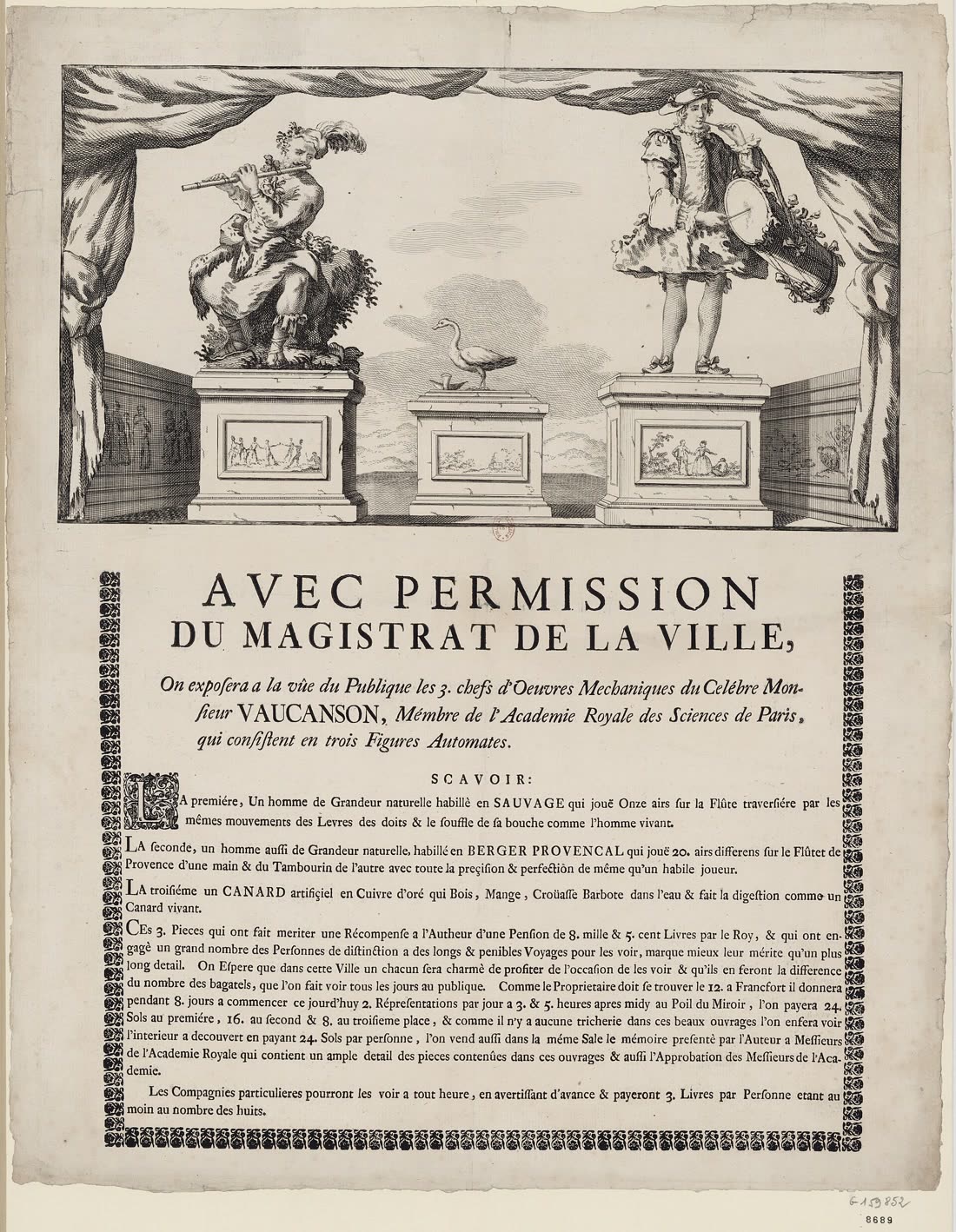
Jacques de Vaucanson’s machines were “unveiled in February of 1738 in the grand hall of the Hôtel de Longueville in Paris,” the Linda Hall Library says. “Vaucanson’s Flute Player had lips that changed shape and moved in and out, and a tongue that regulated the airflow,” and a fife-and-drum player stood with it. The library places the duck between the two musicians; some accounts date it a year later.
The duck “could move its head, flap its wings, drink water, eat corn and grain,” but its digestion was a trick. “Vaucanson claimed that the Defecating Duck was actually processing its food intake,” while “later investigation showed that the ingested food went into one internal cavity.” The musicians were “eventually lost or burned,” and the duck “seems to have survived until the end of the 19th century.”
The Turk, and the showmen who toured automata
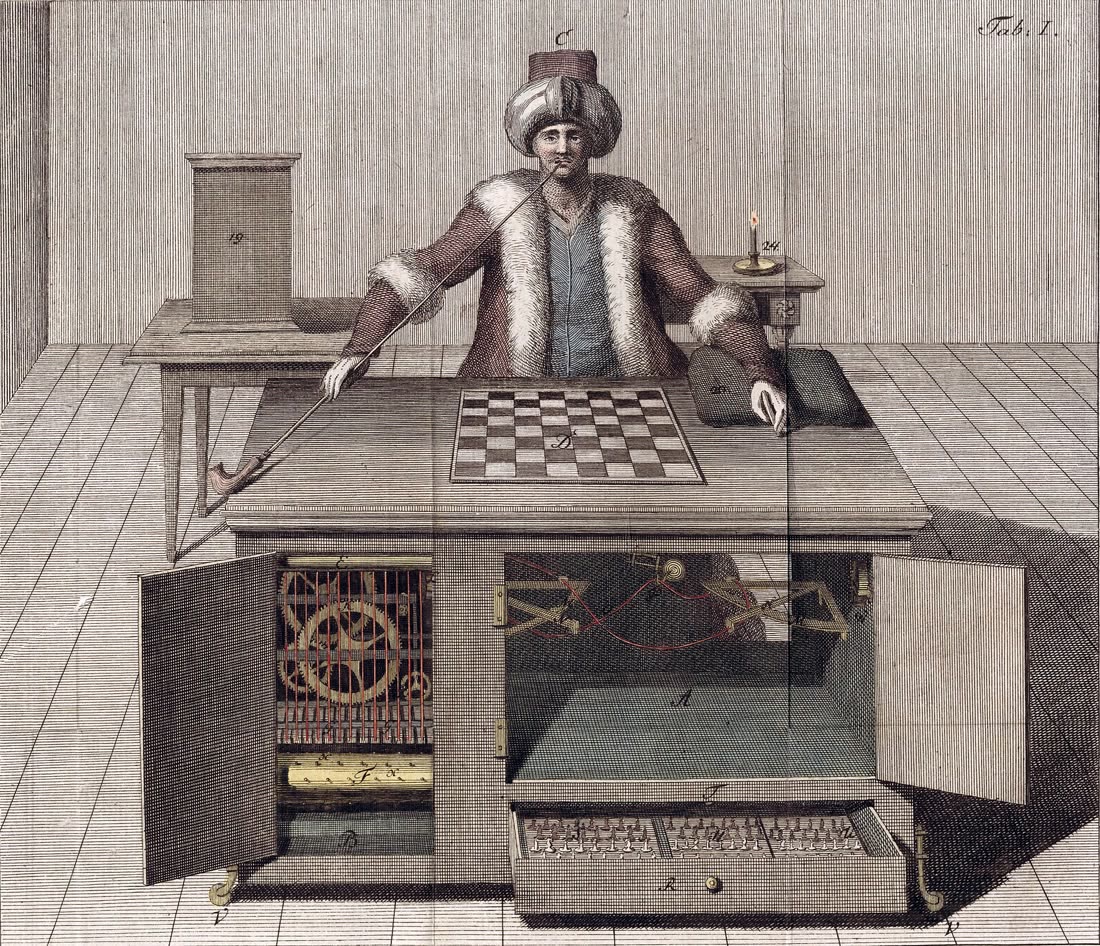
Not every automaton was what it claimed. “In 1770, von Kempelen unveiled one of the most famous automatons in history, a chess-playing machine known as ‘The Turk’,” but “The Turk was controlled by a human ‘director’, seated on a sliding chair down below.”
After Kempelen died in 1804 the showman Johann Nepomuk Maelzel bought it, and “in 1826, Maelzel took the Turk, a Panharmonicon, the panorama, and the Trumpeter” to the United States. In Richmond in 1835 Edgar Allan Poe saw it and wrote an essay claiming to deduce its secret, which, the Linda Hall Library says, he had not. The Turk burned in Peale’s Museum in Philadelphia on July 5, 1854.
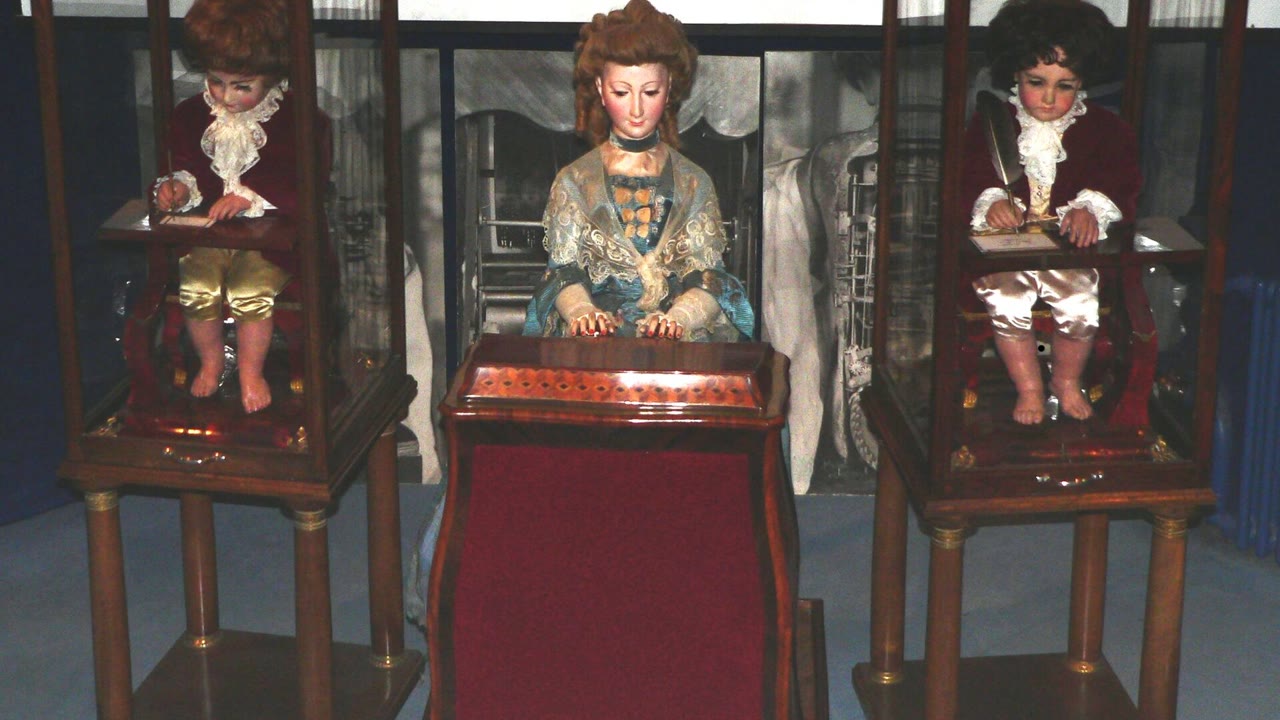
The Jaquet-Droz automata: writer, draughtsman and musician
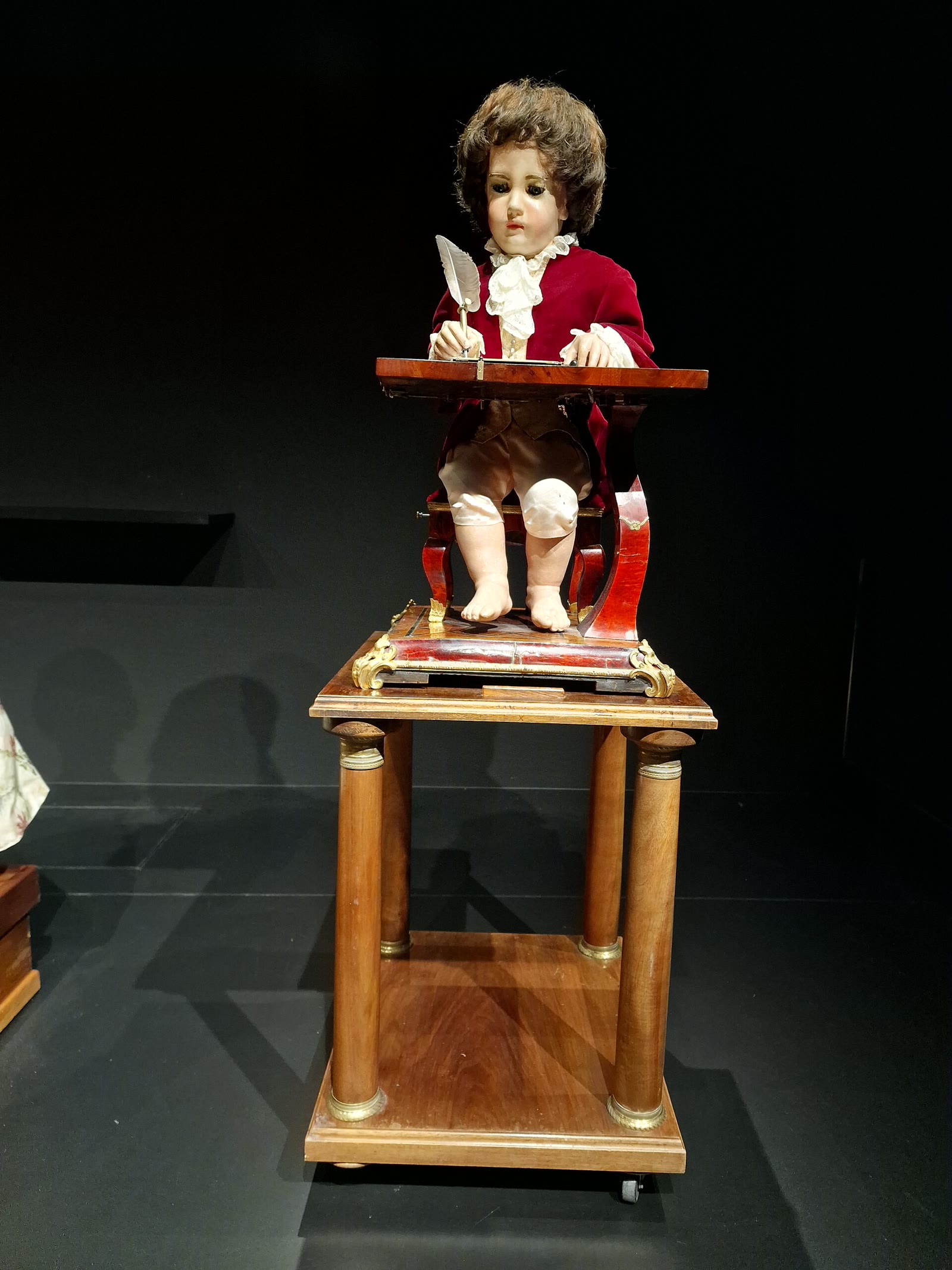
The Neuchâtel art and history museum’s page on the Jaquet-Droz automata (in French) says the Writer, the Musician and the Draughtsman were made in La Chaux-de-Fonds between 1768 and 1774 by Pierre Jaquet-Droz, his son Henri-Louis and Jean-Frédéric Leschot. They have belonged to the city of Neuchâtel since May 1, 1909. They were built “using only a jeweler’s saw, a drill, a lathe, files, and a few other hand- or foot-powered tools,” the Linda Hall Library notes.
The Writer “dips a real quill pen into real ink and writes a short sentence of up to 40 characters,” with “all of the gears, cams, and cam followers” inside the boy’s body. The Draughtsman draws a small set of pictures in charcoal, and the Musician, a young woman, plays a small keyboard. The museum still demonstrates those two, but it says the Writer is not in working order because of a defective part, though it remains on display.
Maillardet’s writing boy
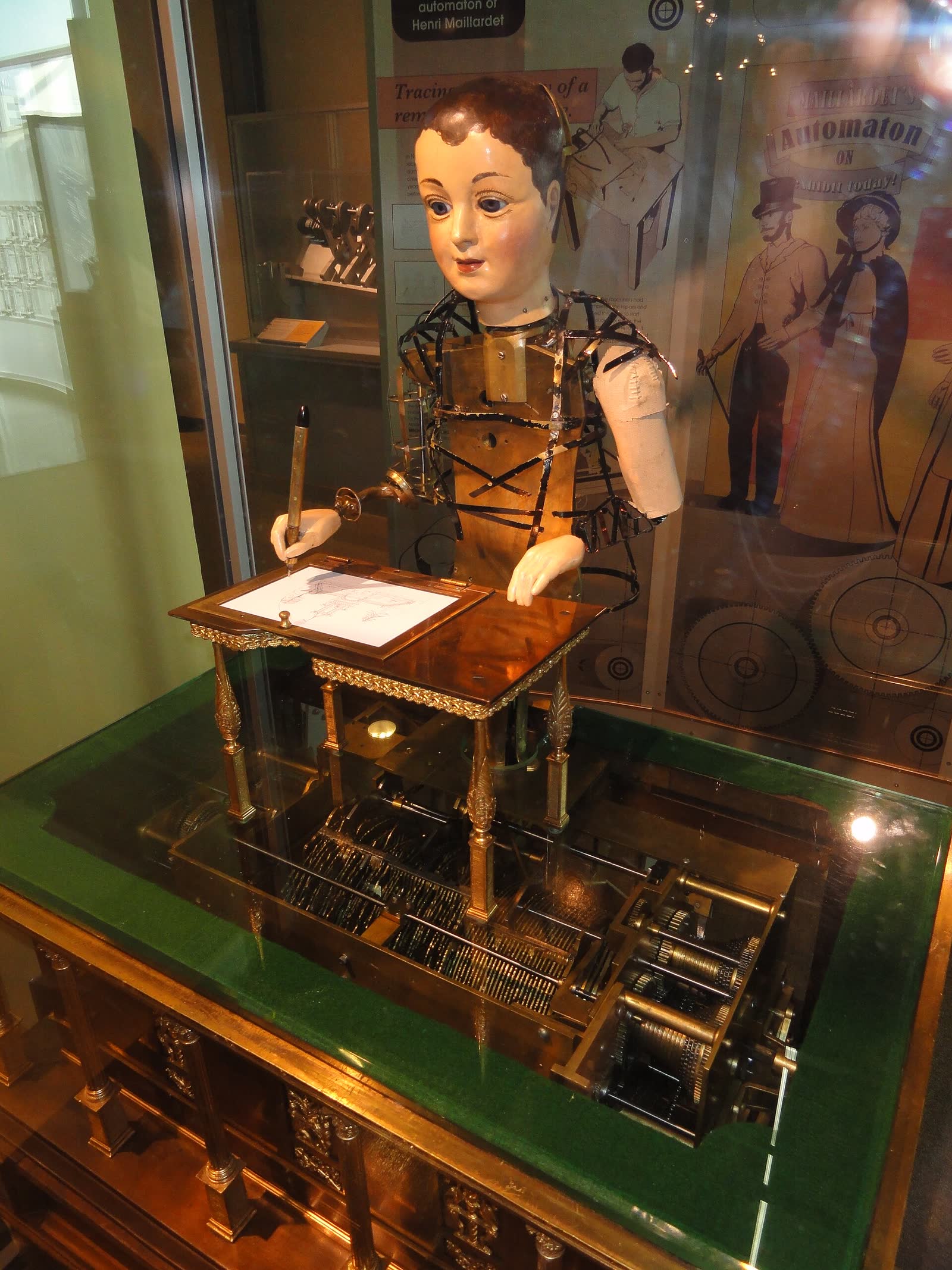
“It is believed that Maillardet built this extraordinary Automaton around 1800,” says the Franklin Institute’s page on Maillardet’s automaton. Henri Maillardet, a Swiss mechanician working in London, “would regularly stage exhibitions of his various automata in London,” and the machine was “later acquired by the showman Johann Nepomuk Maelzel and taken on tour.”
In November 1928 “a truck pulled up to The Franklin Institute science museum in Philadelphia” with the machine, a gift from the estate of John Penn Brock, whose family believed Maelzel had made it. Its memory, stored in brass cams, holds four drawings and three poems, and the border of the last poem reads “Ecrit par L’Automate de Maillardet,” which named its maker. Watching its repair inspired Brian Selznick’s The Invention of Hugo Cabret.
| Date | Machine | Maker | Where now |
|---|---|---|---|
| 1st century CE | Mobile and stationary automata | Hero of Alexandria | Known from manuscripts; modern reconstructions |
| 1206 | Elephant clock, musical boat | Al-Jazari | Known from copies of his book |
| 1738 | Flute player, fife-and-drum player, duck | Jacques de Vaucanson | Lost |
| 1770 | The Turk (a hidden human player) | Wolfgang von Kempelen | Burned in Philadelphia, 1854 |
| 1768-1774 | Writer, Draughtsman, Musician | The Jaquet-Droz workshop and Leschot | Neuchâtel, since 1909 |
| About 1800 | Writing and drawing boy | Henri Maillardet | Franklin Institute, since 1928 |
Scenes that run themselves: Antenna Theater
Antenna Theater never built an automaton, and no source ties Chris Hardman to these machines. Still, the old idea of a scene that runs itself has a cousin in Antenna’s walk-throughs. Reviewing Etiquette of the Undercaste in 1988, Steven Winn of the San Francisco Chronicle described “stylized wooden silhouettes with outstretched arms” in one room: “Mounted like the four axes on turnstiles, these mute men rustle and shift away from us as we pass through the room.”
In 1992 the Philadelphia Inquirer found visitors “jabbing at a mechanical boxer” in the same show, and Moving Sculptures, Antenna’s 1982 street figures, had already put plywood residents on view. Hardman wrote in 1983 that taped instructions needed gestures everyone knew: “acting like a robot or Groucho is definitely still in.”
The difference is where the visitor stood. Hero’s audience watched from outside the frame; Antenna’s audience walked inside the scene, and the tape did the work of the falling weight. The twentieth century’s own moving figures are in the history of Audio-Animatronics, and San Francisco’s coin-operated ones in the Musée Mécanique’s arcade of automata.
Things that perform without a performer also run through object theatre and Mummenschanz’s mask theatre, and Antenna’s own method is set out in Walkmanology and Antenna’s new theater forms.
Frequently asked questions
Do the Jaquet-Droz automata still work?
Two do. The Musician and the Draughtsman are still demonstrated in Neuchâtel, but the museum says the Writer is out of order because of a defective part.
What did Vaucanson’s duck do?
It moved its head, flapped its wings, drank and ate grain, and appeared to digest it, though the food actually went into a hidden internal cavity.
Was the Mechanical Turk a real automaton?
No. It was controlled by a hidden human director seated on a sliding chair down below.