
On Sight (in Sausalito): Antenna Theater’s Centennial Walk Through a Bohemian Town (1993)
In the summer of 1993, Antenna Theater turned its home town into a stage. On Sight in Sausalito, as the company’s chronology titles it, led an audience in radio headsets past masked actors, through City Hall, a park and a harbor parking lot, and through some forty years of the town’s bohemian history. Two full reviews from that August survive, reprinted on the company’s former website.
Quick answer
What was On Sight (in Sausalito)?
On Sight (in Sausalito) was a 1993 Antenna Theater show that used the whole town as its stage. Wearing radio headsets, the audience followed masked actors from City Hall to the waterfront through forty years of local history, meeting Jean Varda, Alan Watts and Sterling Hayden along the way.
A town turns 100, and so would Varda
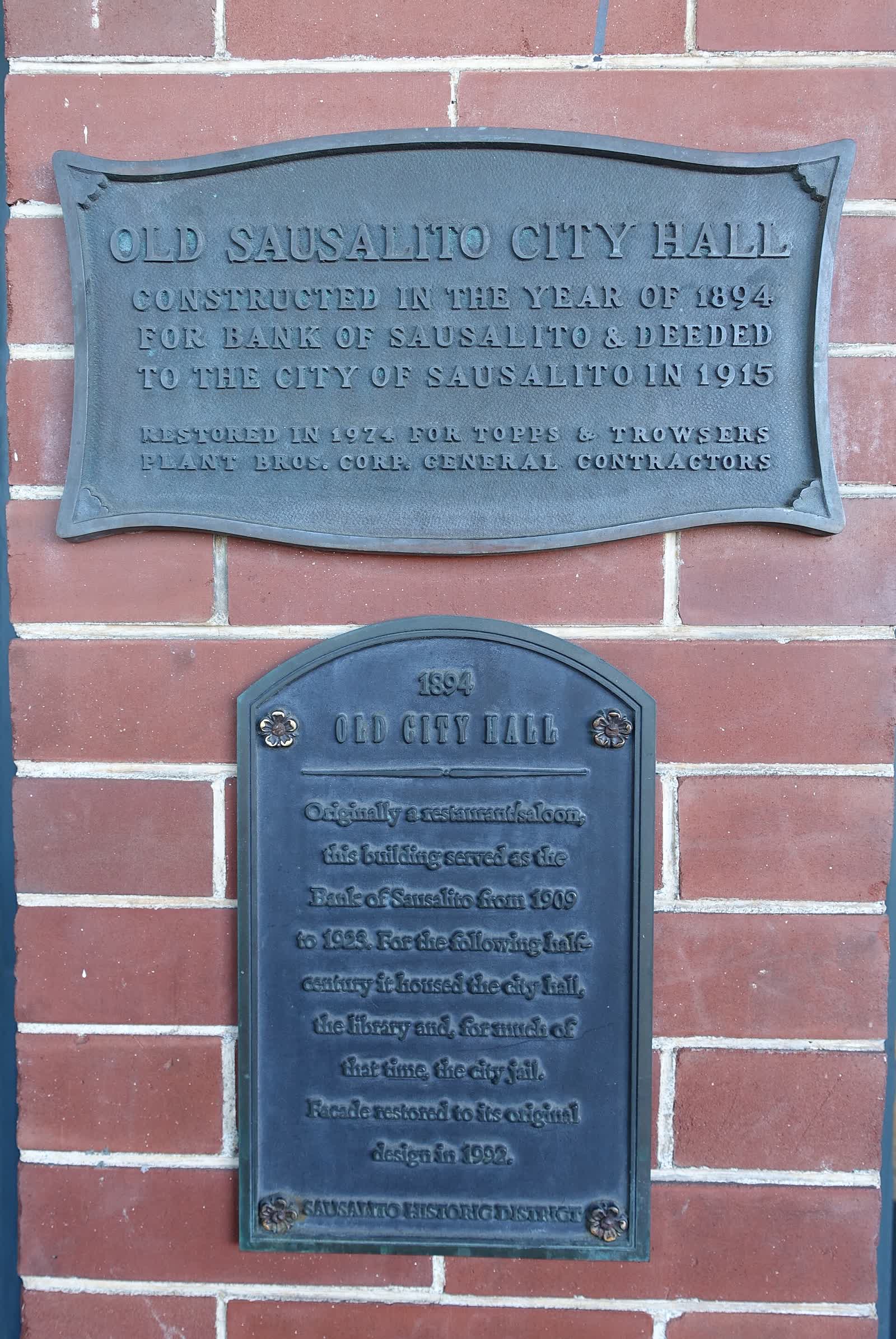
1993 was Sausalito’s centennial year. Robert Hurwitt of the San Francisco Examiner noted that the artist Jean Varda, one of the town’s “best known former denizens,” would also have turned 100, and that “Hardman has taken advantage of the coincidental anniversaries to create his own centennial celebration.” Varda was born in 1893 and died in 1971.
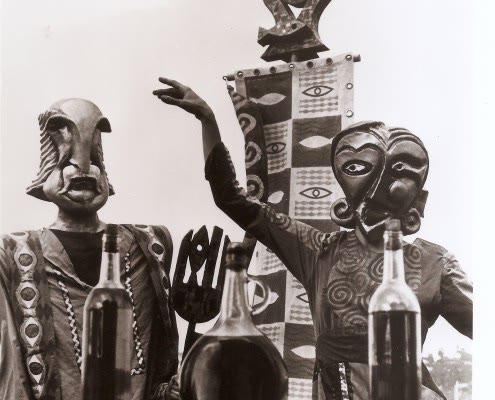
Antenna’s 2003 description sets out the plan: “A site-specific performance using an entire city as its stage.” The show blended “bunraku, shadow performance, cubist-constructivist masks and costumes, fireworks, and an interactive radio broadcast” to explore “the emergence of bohemian lifestyles, art, and Eastern philosophies in post-WWII America.”
How it worked: radio headsets and mimed scenes

“This is theater as a guided tour,” Hurwitt wrote. “The audience, equipped with radio receiver headsets, follows masked actors through several blocks and some 40 years of Sausalito.” At each stop, he explained, “the actors mime scenes” that the audience “hears performed through the headsets.”
Peter Stack of the San Francisco Chronicle saw “costumed actors mime in synch with a dialogue-music-effects track being played on the headsets,” while “Costumed crew people use flashlights and a banner to usher the audience to various stages.” The soundtrack, said the Examiner, was “a sound collage of interviews with former and longtime Sausalitans, and snatches of recordings of Varda and Watts.” The show was “A mere hour in length,” and it used “the night as ambience.”
| Role | Credited to | Source |
|---|---|---|
| Writer and creator | Chris Hardman | Chronicle |
| Director of the mimed scenes | Charlie Queary | Examiner |
| Costumes | Emily Park | Examiner |
| Masks and props | Ronald M. Davis and Chris Hardman | Examiner |
| Music | Roy Marcom; Harry Partch and the Gate 5 Ensemble; Stuart Rabinowitsh; David Torgersen | Examiner |
| Voice of the girl guide | Annette Rose, then a Marin County supervisor and former mayor of Sausalito | Examiner |
The route, stop by stop

Stack listed the stages as “a City Hall meeting room, a neighborhood park, the parking lot of funky old Galilee Harbor, at the foot of Napa Street.” Hurwitt walked the scenes in order, and together the two reviews give the route.
| Stop | Place | Scene |
|---|---|---|
| Opening | Outside City Hall | The 1950s: a weary father walks home uphill, and his briefcase “converts into a large-screen TV set” |
| A white house | A small house with a picket fence | A shadow play of “’50s cultural dissonance through the windows” |
| The hearing | City council chamber, set as a HUAC hearing room | Sterling Hayden resists, then names names |
| Downhill | The streets | A “potbellied old sailor” leads through “a troupe of movie reel-faced dancers” |
| The waterfront | A waterfront park | Varda in an “ornate gold smock” and Watts, “tall, thin, ascetic” |
| The party | A gilded gazebo | Hippies lead the audience to a Watts-Varda party |
| The 1970s | Not stated | A city official begins “issuing selective citations” against houseboats |
| Ending | Not stated | “a happily dancing little conical art-boat” |
| Galilee Harbor | The parking lot at the foot of Napa Street | One stop; neither review says which scene played there |
Varda, Watts and Hayden: the real people behind the masks
Varda, who with Gordon Onslow Ford had acquired the ferryboat Vallejo around 1947 and moored it in Sausalito, appeared as “a giant construction of ornate gold smock and lovingly caricatured, white-haired, droopy mustached mask.” Alan Watts, the philosopher who took over Onslow Ford’s space in 1961, was “tall, thin, ascetic.” His official site is run by the Alan Watts Organization.
The Chronicle reported Varda’s warning that “the undoing of not only Sausalito but America would be the proliferation of white bathrooms and leak-proof plumbing.” Hurwitt wrote that, to Hardman, Sausalito “is an on-going experiment in the phenomenon” that Watts called selective perception.
Sterling Hayden, the actor who testified before the House Un-American Activities Committee in 1951 and named names, appeared in “an elongated, craggy, unshaven mask.” In the Chronicle’s telling, he “went on to a life of whiskey and self-hate.” Hayden later lived in Sausalito and died there in 1986.
The houseboat wars, from Snake Theater to the stage
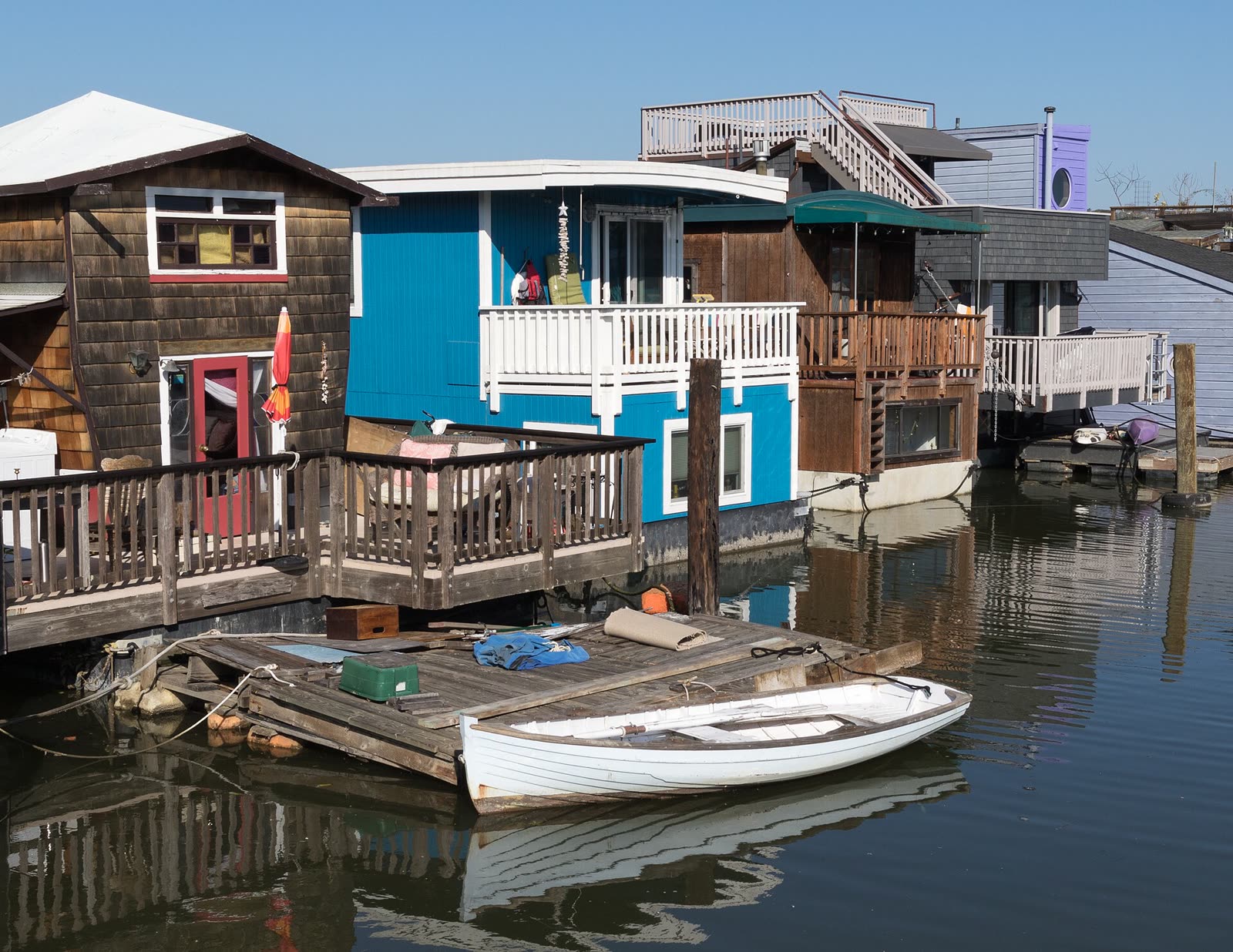
In the show’s 1970s scenes, the city official, called Dick Larson in the Examiner, begins issuing citations to the houseboats, and Varda and company “concoct ever more creative defenses.” Hurwitt saw the irony: “What to them is creative anti-materialism is poverty and urban blight to the newly arrived residents of expensive hill homes.”
The fight was real, and Hardman had been in it. Floating Times’ history of Sausalito’s water wars records that on April 7, 1977, “Snake Theatre kicked into high gear, creating massive puppets to artistically confront the developers’ building.” That June the troupe unveiled its Cardboard People to protest the bulldozing, work that belongs to Snake Theater’s productions before Antenna.
Bob’s Boatyard at Napa Street was incorporated “in 1980 as Galilee Harbor,” and the show used the harbor’s parking lot as a stage. It was also the live-aboard community where Hardman and Rose lived for more than twenty years, and where a fire in 2006 led to Fire and Ice, the piece about the night their tugboat home burned.
What the critics said
Hurwitt called it “a clever, quirky and exhilarating civic tour through time and space, art and politics, history and the imagination,” and wrote that “The script grows richer and ever more layered with tongue-in-cheek connections.” He found the ending “a bit anticlimactic,” but judged that “the weak ending seems a minor matter.” His verdict on the show’s sights and insights: “simply, well… outtasight.”
Stack called it “arty but accessible experimental theater” and “an enticing night of alternative theater,” adding: “The show is intelligent and fun.” His practical advice was to “plan on wearing warm clothes and good shoes.”
The show is one row in site-specific theater in the Bay Area, and its walking audience fits what promenade theatre is and how it moves a crowd. The scene that shaped Hardman is traced in San Francisco performance art history.
Frequently asked questions
When did On Sight (in Sausalito) run?
It opened on a Friday in early August 1993, and the San Francisco Chronicle listed it through September 11.
How long was it?
About an hour, according to the San Francisco Examiner.
Who were the characters?
Jean Varda, Alan Watts and Sterling Hayden, a 1950s family, hippies, and a city official issuing citations to houseboats.
Who voiced the guide?
Annette Rose, then a Marin County supervisor and a former mayor of Sausalito, according to the San Francisco Examiner.
On Sight has an entry in Antenna Theater’s full production chronology, and its mask maker Ronald M. Davis also designed Etiquette of the Undercaste, the walk-through of poverty.