What Is Anaglyph Art? Red and Cyan 3D, from Victorian Parlours to the Gallery
Put on cardboard glasses with one red lens and one cyan lens, and a flat page suddenly has depth. So what is anaglyph art, and where did it come from? The answer runs from Victorian parlour games through the 3-D comics of 1953 to the surface of Mars, with a stop in a Sausalito warehouse where Antenna Theater handed its audience 3-D glasses.
Quick answer
What is anaglyph art?
Anaglyph art is a 3D picture made from two slightly different views of the same scene, printed on top of each other in contrasting colours, usually red and cyan. Glasses with matching coloured lenses send one view to each eye, and the brain fuses them into a single image with depth.
How an anaglyph works: two views, two colours, one brain
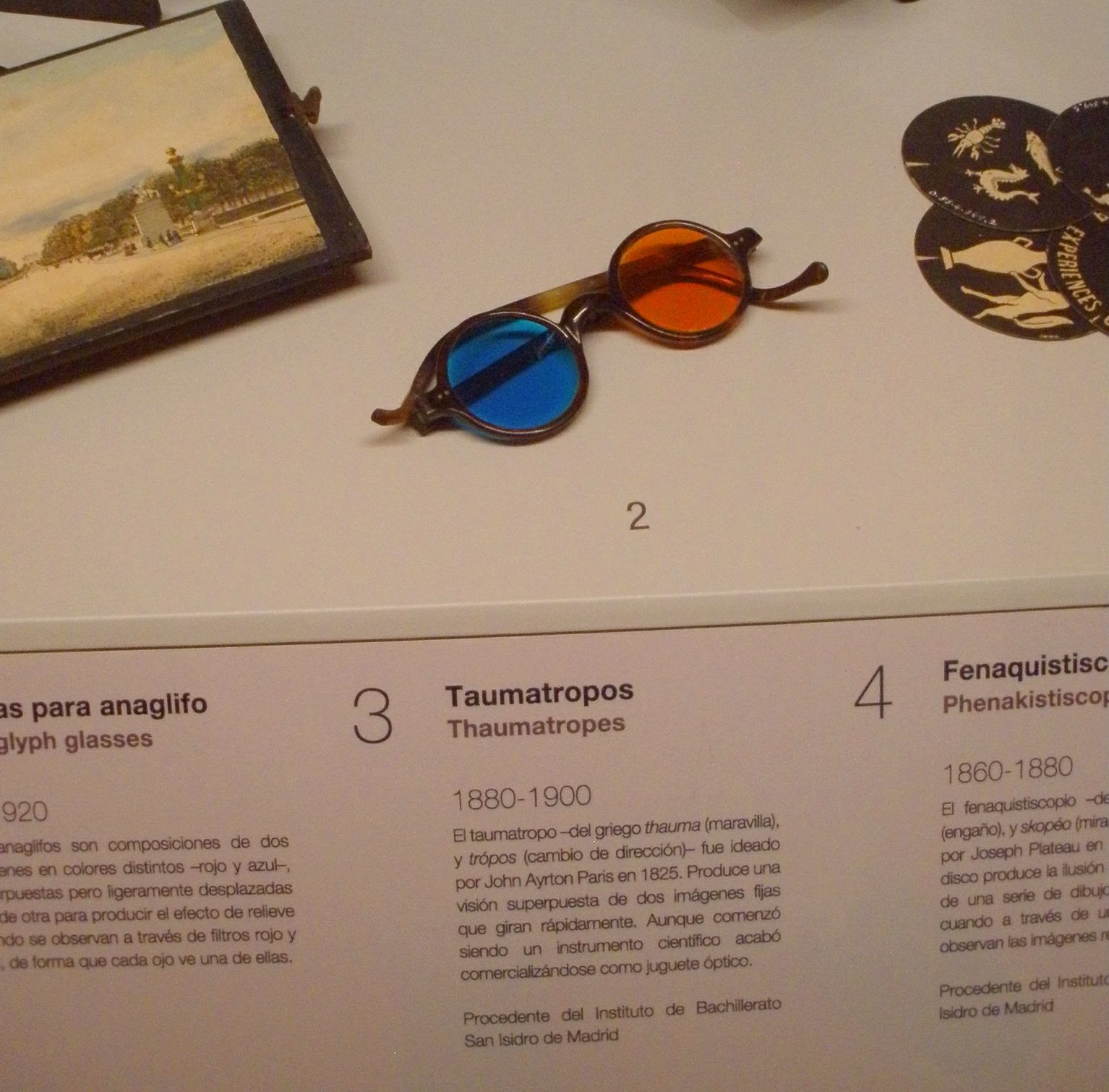
The word is Greek. A Utah State University history of stereoscopic pictures glosses it as an object “shaped relief-like, i.e., has a non-flat surface.” The method is just as compact: “Two projections of a 3-D image looked at through filter glasses.” Each lens filters out one image, and the brain combines the two into depth.
The colours vary with the medium: the same history lists “red-green (print), red-cyan (CRT), also: red-blue & magenta-green.” The price is colour itself. Anaglyph 3-D “degrades color,” the 3-D Film Archive notes, which is why red cyan 3D images look tinted. An anaglyph drawing follows the same rule: two slightly different views, each in its own colour, laid over each other.
1838 to 1900: from stereoscope to parlour game

The anaglyph grew out of stereoscopy. Wheatstone explained stereoscopic vision in 1838, Rollmann described anaglyphs in 1853, and the French teacher Joseph Charles d’Almeida “used differently colored light to produce anaglyphs” in 1858. The name came last, from Louis Ducos du Hauron in 1891.
By about 1900, anaglyphs were boxed home entertainment. The Science Museum Group holds a Redheffer set of 13 anaglyph pictures with red and green spectacles, made in Chicago around 1900 and “patented 1895.” Its views include the “East Front of Capitol, Washington D.C.” In the 1930s and 1940s, anaglyphs were used in geometry lessons.
1953: the comic-book boom
For most Americans, coloured glasses arrived with comic books. Joe Kubert, who engineered the first 3-D comics with Norm and Lenny Maurer, told The Comics Journal he had seen “copies of magazines with inserted red and green glasses” while stationed in Germany. The craft, he said, was “Matching the inks to the glasses, the designing of the glasses, etc., we had to be designers and engineers.”
It paid: “The first 3-D books sold a million and a quarter copies at 25 cents a shot, which was unheard of at that time.” Kubert named the 3-D Mighty Mouse among the titles.
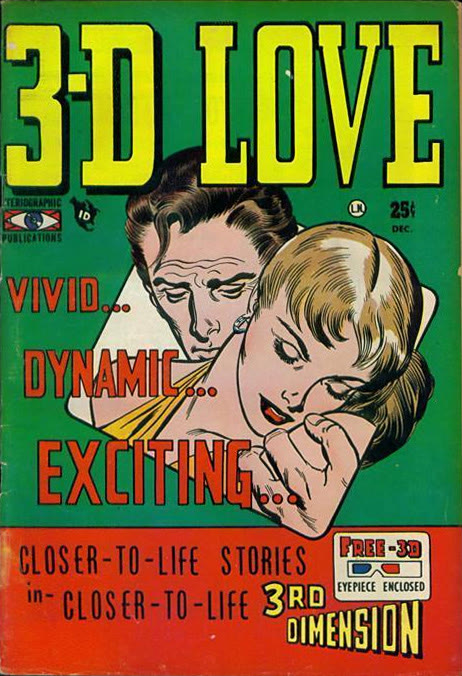
Then the fashion burned out. “When the market was saturated with 3-D, it was so common, readers began to ask, ‘Hey, what about the story? What about the content?’” The cover shown here, 3-D Love, is a romance title from the same boom drawn by Ross Andru, not one of Kubert’s books.
The 3-D movie myth
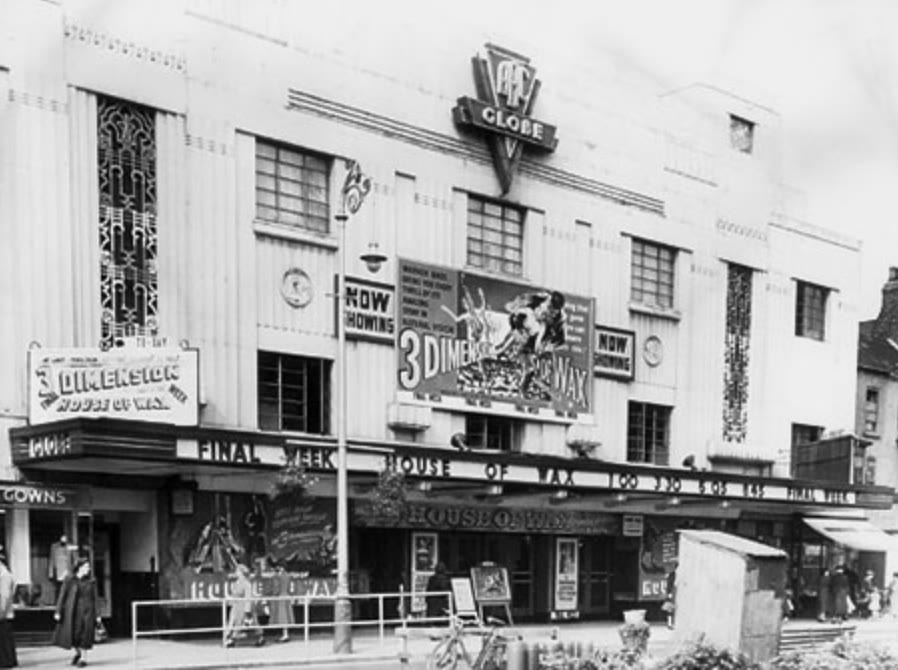
Many people remember 1950s 3-D films as red and blue. The 3-D Film Archive’s list of top ten 3-D myths disagrees: apart from three Lippert shorts and some burlesque shorts in 1953 and 1954, “all of the 3-D features, shorts, and cartoons exhibited in commercial theaters from 1952 through 1955 were projected using polarized light.”
The coloured glasses came from print: “When anaglyphic comics appeared in the last quarter of 1953, the colored 3-D glasses became commonplace.” Later reissues blurred the memory, as polarized films were converted to anaglyph in the 1970s and 1980s. One real anaglyph film scene came in 1961, when the dream sequences of The Mask “were shown in anaglyph 3D,” according to the Science Museum, which keeps the film’s “Magic Mystic Glasses.”
| Aspect | Anaglyph | Polarized |
|---|---|---|
| Glasses | Coloured lenses: red-green, red-cyan, red-blue | Polarizing filters |
| Colour | Degraded | Full colour |
| Works on | Paper, comics, any screen | Projection with polarizing filters |
| Famous uses | 1953 comics; The Mask (1961); later reissues | Most 3-D films shown from 1952 to 1955 |
Anaglyph 3D art today: Thomas Ruff’s Mars

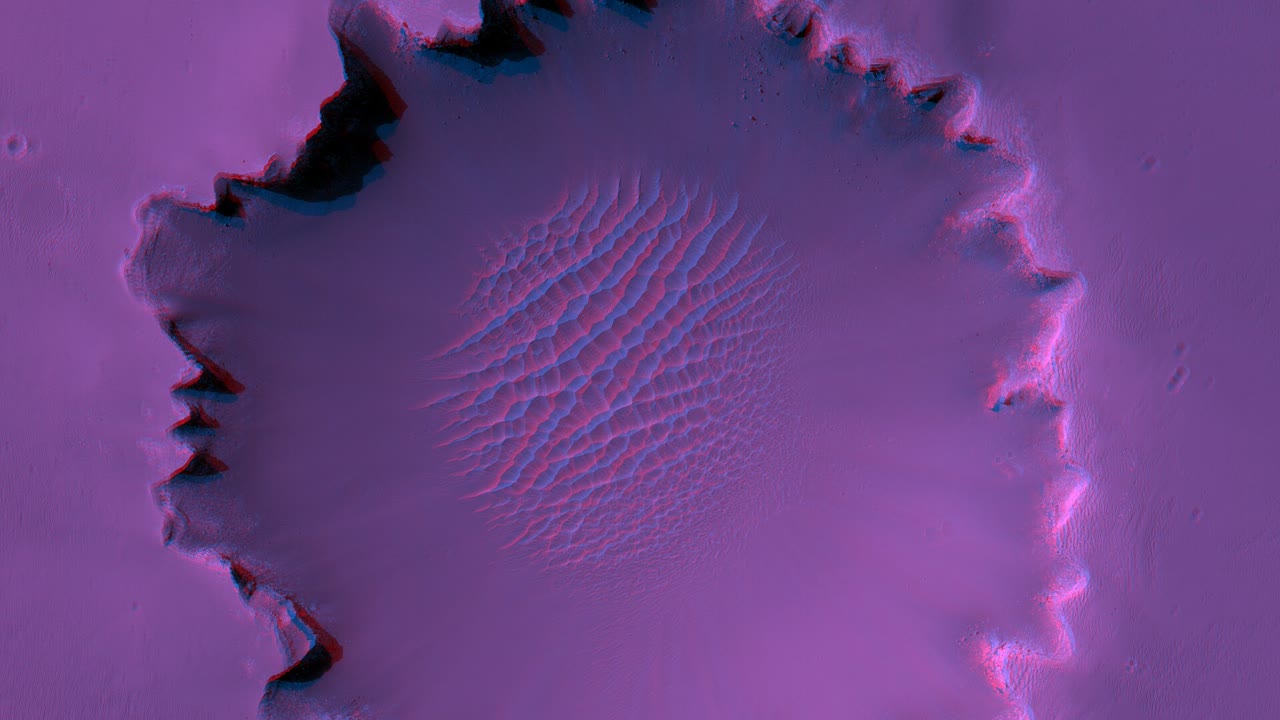
Anaglyphs have also found a place in galleries. Thomas Ruff’s ma.r.s. series begins with “black-and-white satellite photographs of the surface of Mars,” taken with the HiRISE camera on NASA’s Mars Reconnaissance Orbiter. Ruff rendered some surfaces “as 3D images, using a technique originally developed in the nineteenth century to convey the illusion of depth.”
Part of the point is a joke, his statement for the Prix Pictet says: “you can actually recognize deep relief on the surface of another planet with cheap 3D glasses.” The pictures on this page are NASA’s own images, not Ruff’s work.
Antenna Theater’s 3-D: “there-not-there”
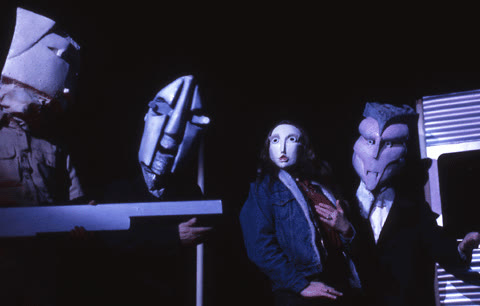
Chris Hardman had cardboard glasses in mind early. In 1983 he wrote: “In movie houses we’ve worn cardboard 3D glasses and sniffed smell-o-ramas, we’ve been surrounded by split screens and quad sounds.” All of them, he argued, were “attempts at delivering to audiences the experience of entering through a looking-glass.”
Dracula in the Desert put 3-D at the centre. Antenna staged it in a warehouse on the Sausalito waterfront in November and December 1986, though the company chronology lists it under 1985. The premise: “Dracula discovers that Ray-Bans make it possible for him to walk in the sun.”
Robert Hurwitt’s preview in the San Francisco Chronicle described “one room that is set up as a 3-D film studio with cameras focused on a Hardmanesque desert set model.” He added: “Each member of the audience will be given a pair of 3-D glasses.” Hardman wanted the pictures to match the soundtrack on the headsets: “It gives the visual world the same there-not-there feeling as the tape.” The audience moved too, and he noticed: “It’s uncanny what happens with 3-D when you move people around in front of it.”
| Year | Milestone |
|---|---|
| 1838 | Wheatstone explains stereoscopic vision |
| 1853 | Rollmann describes anaglyphs |
| 1858 | d’Almeida produces anaglyphs with coloured light |
| 1891 | Ducos du Hauron names the anaglyph |
| c.1900 | Boxed anaglyph pictures with red and green spectacles |
| 1953 | 3-D comics sell a million and a quarter copies |
| 1961 | The Mask shows its dream scenes in anaglyph 3D |
| 1986 | Antenna’s Dracula in the Desert hands out 3-D glasses |
| 2010s | Thomas Ruff’s 3-D pictures of Mars |
Antenna’s documented anaglyphs came later, in the anaglyph prints in Hardman’s Transforming Art, part of Hardman’s exhibitions and artifacts. Dracula sits in the Snake and Antenna chronology and among Antenna’s new theater forms. Two cousins of the anaglyph turn flat things into depth: Pepper’s ghost, the glass illusion, and slotted cardboard sculpture.
Frequently asked questions
What does anaglyph mean?
The word comes from Greek and means, roughly, shaped in relief: an object with a surface that is not flat.
Who invented the anaglyph?
Rollmann described it in 1853, Joseph Charles d’Almeida produced anaglyphs with coloured light in 1858, and Louis Ducos du Hauron gave them their name in 1891.
Were 1950s 3-D movies red and blue?
Almost never. The 3-D Film Archive found that nearly all 3-D films in commercial theaters from 1952 to 1955 were polarized. Coloured glasses became common with the 3-D comics of late 1953.
Did Antenna Theater use 3-D?
Yes. Dracula in the Desert gave every audience member a pair of 3-D glasses for images filmed on a model desert set, and Chris Hardman’s later gallery show Transforming Art used anaglyph prints.