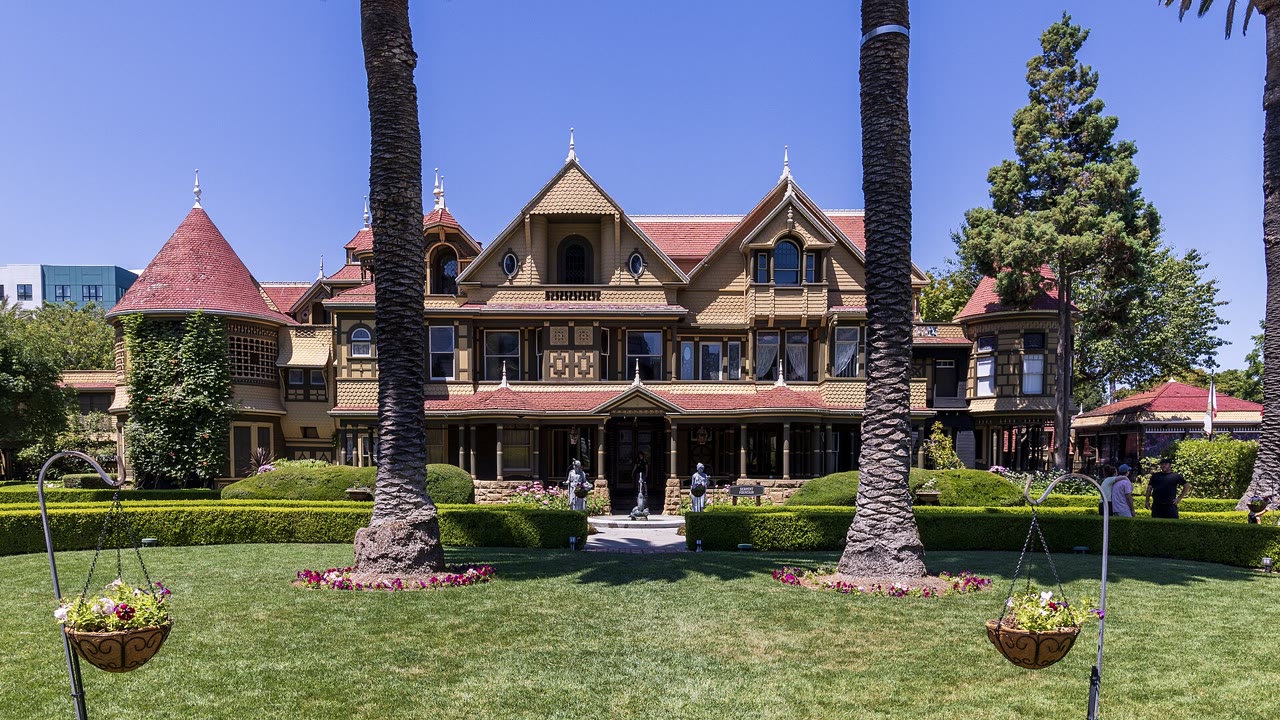
Winchester Mystery House History: The Woman, the House and the Legend
Winchester Mystery House history is three histories tangled together: a widow who kept remodelling a farmhouse for decades, a building that grew and then partly fell, and an attraction that supplied the ghosts. Pulling them apart shows how much of the famous story arrived after Sarah Winchester died.
Quick answer
What is the history of the Winchester Mystery House?
The Winchester Mystery House in San Jose grew from a farmhouse Sarah Winchester bought in the 1880s into a sprawling mansion she remodelled until her death in 1922. In 1923 John and Mayme Brown opened it for tours, and the ghost legend grew with the attraction. Her biographer finds little evidence for it.
Who was Sarah Winchester? The years before San Jose
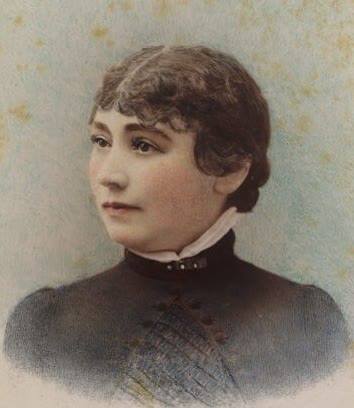
Sarah Lockwood Pardee was born in New Haven, Connecticut, in 1839 (some sources say 1840). On September 30, 1862, she married William Winchester, heir to the Winchester Repeating Arms Company. Their only child, Annie, was born in July 1866 and died “a mere five-and-a-half weeks after her birth, from marasmus,” in the words of the attraction’s timeline.
William died of tuberculosis in March 1881, at 43, leaving her, reportedly, $20 million and nearly half the company’s stock.
Her biographer Mary Jo Ignoffo frames the choice that followed: “She could stay in New Haven, live on Prospect Hill with her aging mother-in-law, and do charity work. Or, she could leave the city of her birth, strike out on her own, and build a new life. She opted for the latter.”
The house that grew, 1886 to 1922
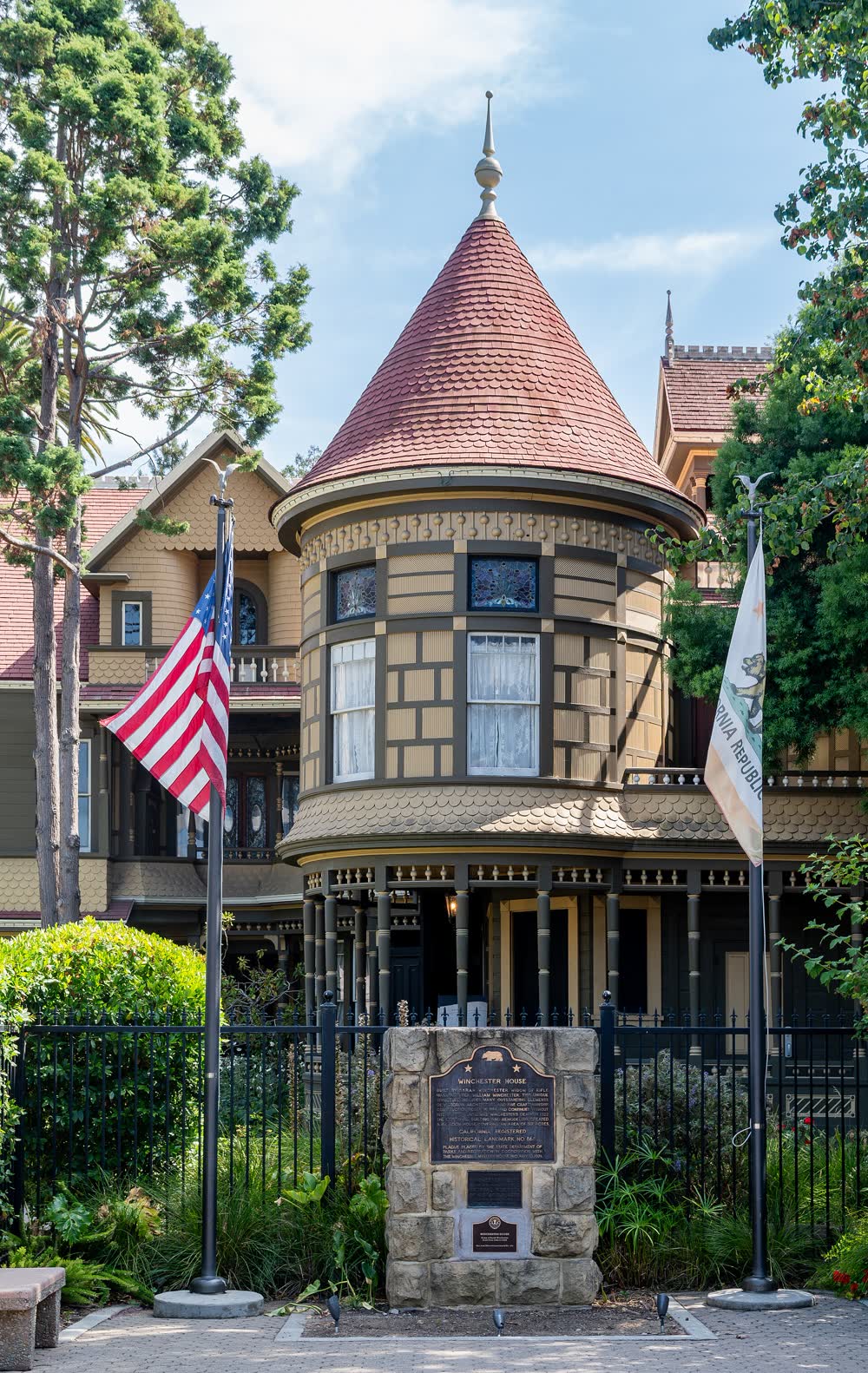
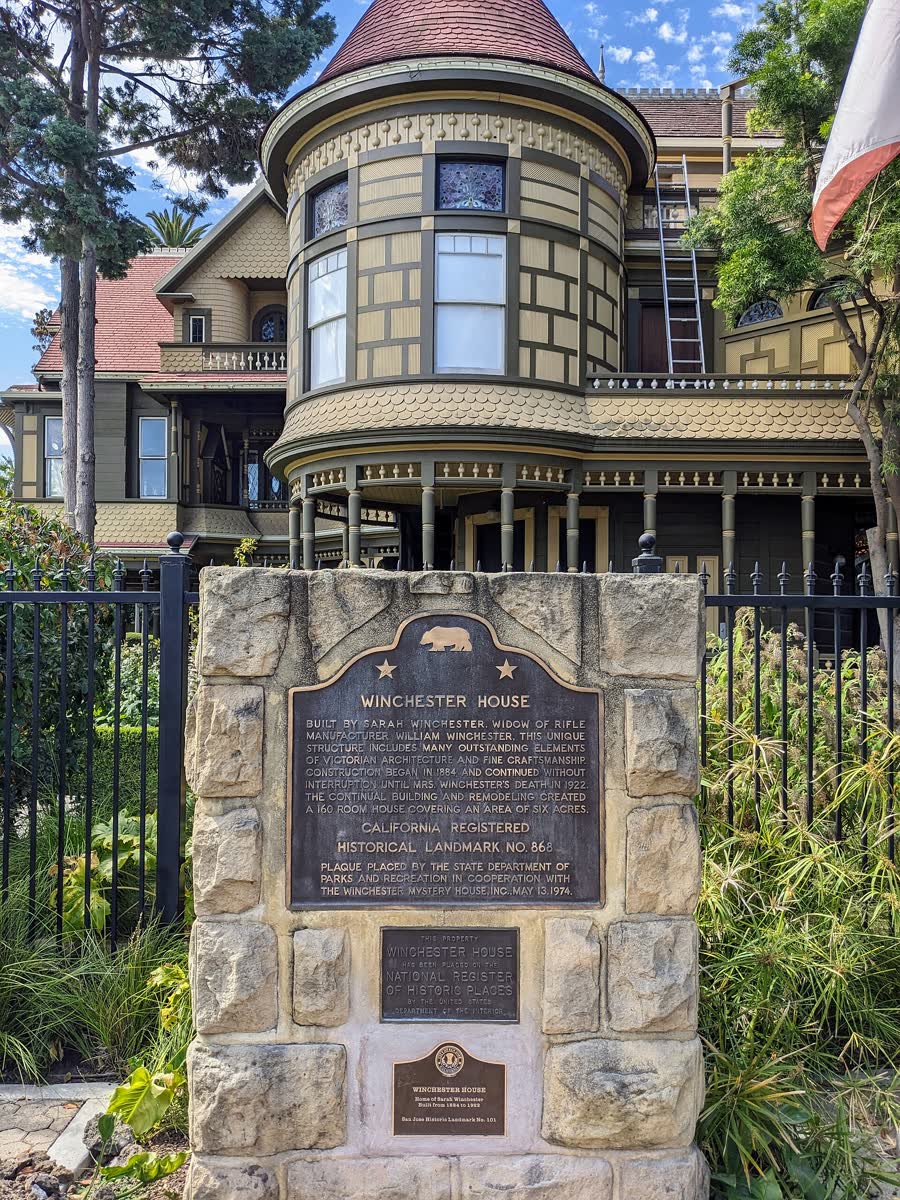
The dates start with a conflict. The state’s record for California Historical Landmark 868 says “Construction began in 1884 and continued without interruption until Mrs. Winchester’s death in 1922.” The attraction’s own timeline of Sarah Winchester’s life has her buying “a two-story farmhouse near San Jose” in 1886, and Ignoffo also dates her move to 1886.
The timeline calls the 1890s “the heyday of the mansion’s construction,” when it rose to seven storeys. The owners count 160 rooms, 10,000 windows and 2,000 doors, built “without a master plan.”
Then came the 1906 earthquake. “The upper floors toppled in the earthquake of 1906. She did not replace the upper stories,” Ignoffo told 7×7.
Her letters sound like a busy owner, not a haunted one. In 1898 she wrote, “I am constantly having to make an upheaval for some reason,” and of one stretch: “I became rather worn and tired out and dismissed all the workmen to take such rest as I might through the winter.” She died at Llanada Villa on September 5, 1922.
How the legend was built
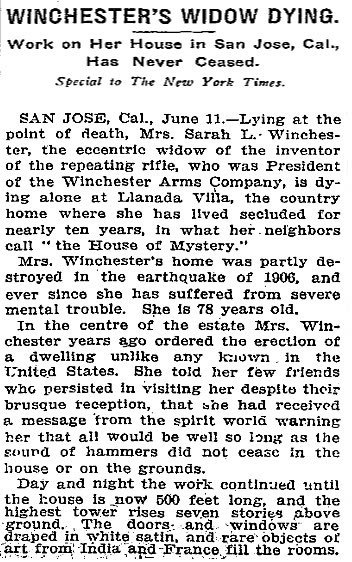
A San Francisco Chronicle story (the attraction dates it to February 24, 1895; the Saturday Evening Post says 1885) was “the first known written story suggesting that Sarah Winchester was building her home to avoid death.” As the Post quotes it: “The reason for it is in Mrs. Winchester’s belief that when the house is entirely finished, she will die.”
In June 1911 the San Francisco Examiner called the mansion a “House of Mystery,” and that year The New York Times “was repeating the story almost verbatim.” A 1939 Federal Writers’ Project guide added a “white satin chamber” where she would “commune with her departed mate.”
| Legend | Record |
|---|---|
| A medium told her to build without stopping | No document of such advice; her letters say she dismissed the workmen for a winter |
| Building went on day and night | She sent workers away for months at a time |
| Stairs and doors to nowhere confuse ghosts | Sealed-off earthquake damage she chose not to repair |
| Nightly séances in a secret room | No séance documented; no séance room mentioned before a 1928 article |
| An obsession with 13 | References added after her death |
| Guilt over the rifle | Pride was more likely than guilt |
The Browns and the first Winchester Mystery House tours
Her will directed that the property be sold. In April 1923 John and Mayme Brown leased it, hoping at first for a family park; the attraction says John had built “one of the earliest known wooden Roller-Coasters” in Canada. “But as locals shared stories of Sarah Winchester and begged to see inside, Brown realized the mansion itself had interest.”
The house opened for tours on June 30, 1923, with Mayme Brown as the first guide, and about 10,000 people came that day, by the owner’s count. Ignoffo, as 7×7 summarises her, says the Browns “did not start the rumors” but “embellished the stories wildly and made up new ones.” The attraction also tells of a Houdini visit in 1924, after which, “According to stories, he leaves with more questions than answers.”
Later decades added a wax museum on the grounds, state landmark status and a National Register listing in 1974, and flashlight tours in the 1980s.
| Year | Event |
|---|---|
| 1862 | Sarah Pardee marries William Winchester |
| 1881 | William dies of tuberculosis |
| 1884 or 1886 | She buys a farmhouse near San Jose (state: 1884; owner and Ignoffo: 1886) |
| 1890s | The main building years; the house rises to seven storeys |
| 1906 | Earthquake; the upper floors come down |
| 1922 | Sarah Winchester dies on September 5 |
| 1923 | The Browns open the house for tours on June 30 |
| 1974 | State landmark and National Register listing |
The historian’s case
Ignoffo’s biography, Captive of the Labyrinth (2010, revised 2022), is the main case against the legend. On round-the-clock building: “Winchester’s own letters explain that she sent workers away for months at a time.” On guilt: “A sense of pride was more likely than one of guilt.” On séances, she found “no mentions of a seance room in the house before a 1928 propaganda article, published well after Sarah died.”
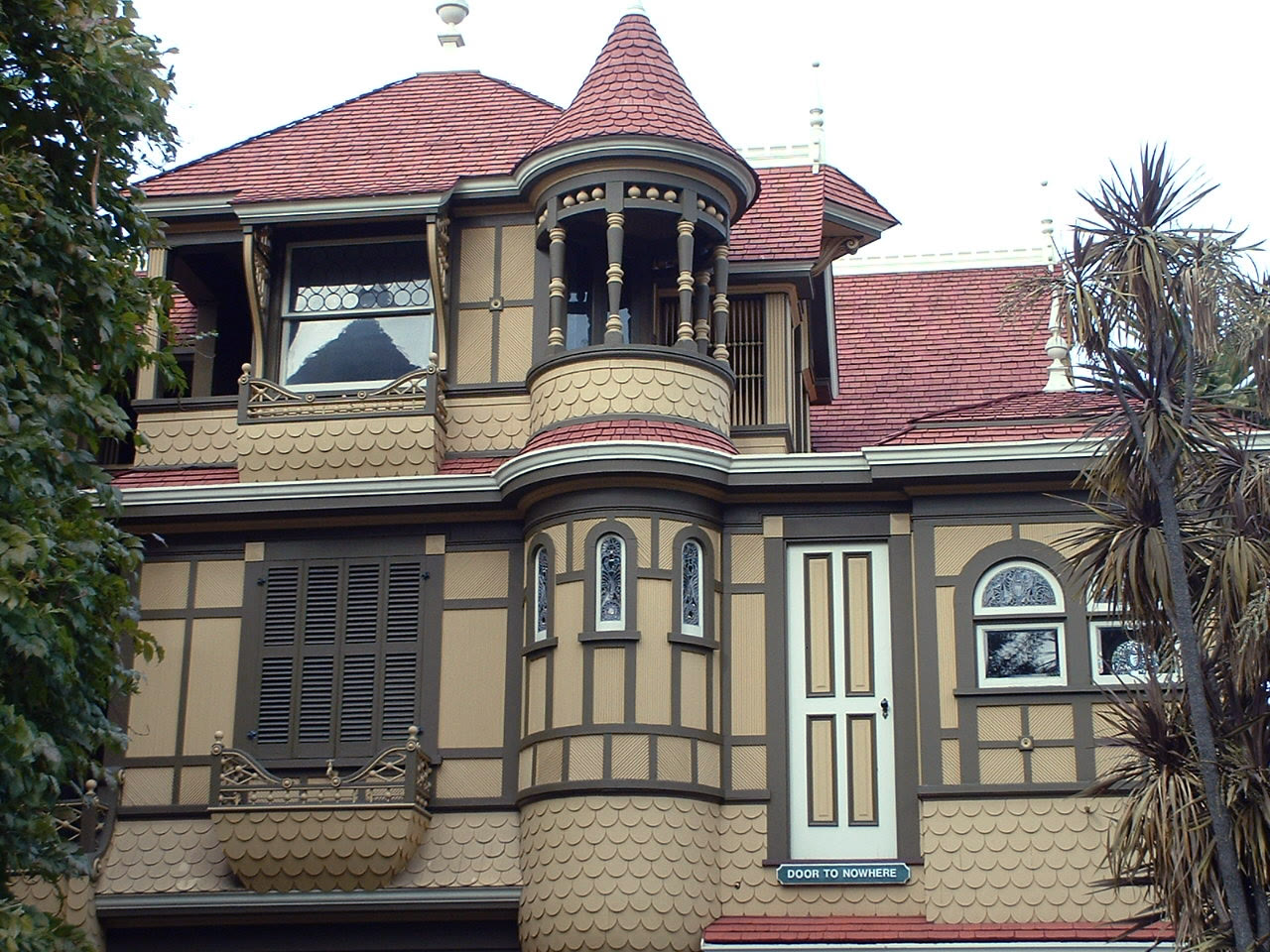
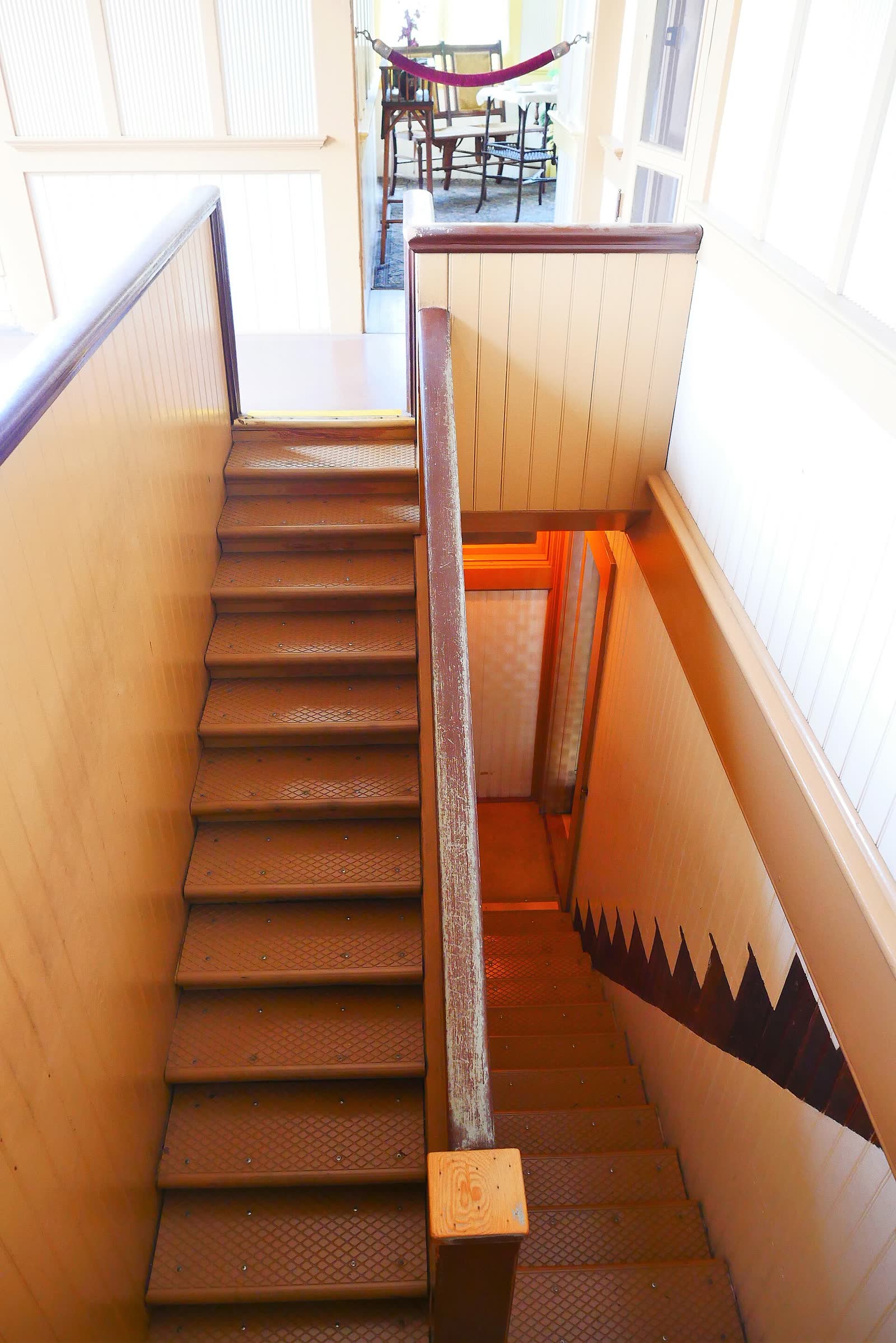
The doors and stairs to nowhere, 7×7 reports, “are merely where damage has been sealed off or where landings have fallen away,” and “it had nothing to do with spirits.” Ignoffo’s verdict: “Sarah Winchester has been exploited for profit for over a century.”
A walk-through with a story added
The Winchester house is a walk-through whose story was supplied after its maker died, by people in the business of showing it. Antenna Theater worked the other way round: its walk-throughs were built around a story the visitor heard on headphones and played a part in, and no source says its founder, Chris Hardman, ever visited or mentioned the Winchester house. Artery made each audient the hero of a noir thriller in a 17-room maze, and The Grid, Antenna’s audio tour of a building, explained a new arts center’s site and architect to each walker.
Hardman had seen the other model up close. Recalling a carnival job, he told Esquire in 1986: “It was cold. The way they treated their audiences, and how they thought of people as marks.” The full story is in how Hardman remembered the carnival.
Haunted houses and ghost walks have their own histories: the history of haunted attractions, from ghost house to dark ride and the ghost tour as a form. Antenna’s mazes are gathered in Antenna’s maze productions and new theater forms, and a very different Bay Area archive is in our Whole Earth Catalog history.
Frequently asked questions
Why did Sarah Winchester keep building?
She never said publicly. The legend credits a medium, but her biographer Mary Jo Ignoffo found letters showing she sent workers away for months at a time.
When did the Winchester Mystery House open for tours?
On June 30, 1923, with Mayme Brown as the first guide, by the attraction’s account.
How many rooms does the house have?
About 160 today, by the owners’ count. It was larger before the 1906 earthquake brought down its upper floors.
Is the house a national landmark?
It is California Historical Landmark No. 868 and was listed on the National Register of Historic Places in 1974. Ignoffo warns that many people wrongly take this to mean public ownership.