The History of Immersive Exhibitions, from Barker’s Panorama to the Van Gogh Shows
The projection halls that filled with Van Gogh’s swirling skies in 2020 sold themselves as something new. The history of immersive exhibitions says otherwise: the walk-in, wraparound picture has been a paid attraction since the 1780s, and it has boomed and gone bust more than once. Today’s immersive art exhibitions are only its latest chapter.
Quick answer
What was the first immersive exhibition?
The panorama. Robert Barker patented a 360-degree painting viewed from a central platform in 1787 and showed it in Edinburgh, then in a London rotunda. Cycloramas spread the idea in the 1880s, and projection halls such as the Atelier des Lumières in Paris (2018) and the Van Gogh shows of 2020 brought it back.
Barker’s panorama, 1787

Panorama painting history begins with a patent. Robert Barker “patented his idea in 1787,” according to the National Records of Scotland, and called it “La nature a coup d’oeil”, nature at a glance. His son Henry Aston Barker, then 12, drew the view from Calton Hill. The Records date the first Edinburgh showing to 1788, while the Open University puts that first panorama in 1792.
In London, “Barker built a wooden rotunda, located at Leicester Square to show his London ‘panorama’, charging one shilling per view.” Visitors walked through a tunnel to a central platform, where a canopy hid the top of the canvas and the light. Barker insisted “There is no deception of glasses, or any other whatever,” yet some first-time visitors felt dizzy or sick.
The panorama craze and the survivor in The Hague

“Panoramas were a global phenomenon during the 19th century,” says Panorama Mesdag’s history of the Panorama of Scheveningen. “As the forerunners of photography and film, travelling panoramas were used to convey news,” and “At one point, there were around 300 panoramas in existence.”
Mesdag’s own was commissioned in 1880 by Brussels investors amid “the Belgian panorama craze that erupted around 1875,” and Mesdag himself painted it in four months with Sientje Mesdag-van Houten, Bernard Blommers, George Hendrik Breitner and Théophile de Bock. It opened on 1 August 1881, measures 114.5 m around and 14.6 m high, and visitors stand on an artificial dune. Near bankruptcy, Mesdag “bought his own masterpiece in 1886,” and it is “the oldest panorama in the world still in its original location.”
Cycloramas in America
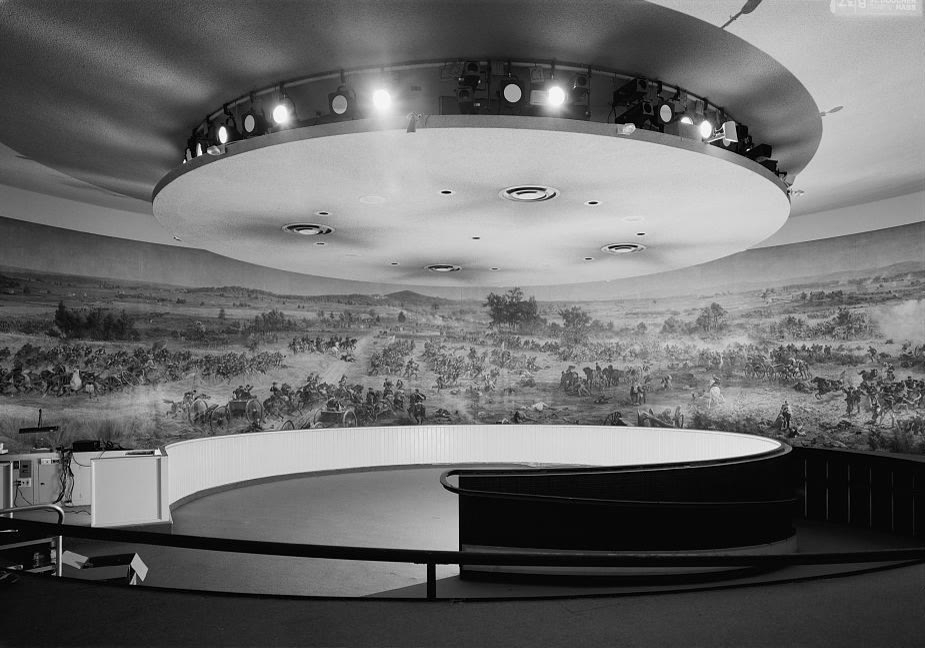
In the United States they were called cycloramas. The New Georgia Encyclopedia describes these “building-sized paintings hung circularly for viewing from the inside” as a European innovation of the late nineteenth century, and Paul Philippoteaux’s Gettysburg cyclorama “came to this country in 1884.” In Milwaukee, William Wehner’s American Panorama Company recruited German painters in 1883.
The Battle of Atlanta debuted in Detroit in February 1887 and opened in Atlanta in 1892. In 1934-36 the WPA added a 3-D foreground with 128 plaster soldiers (Daguerre’s original is covered in the history of the diorama), and a 1979-81 restoration added “a 184-seat, tiered viewing platform, which rotated slowly as recorded narrative described the painting.” Gettysburg’s painting, restored in 2008, is one of very few survivors in the United States.
From slides to laser projectors
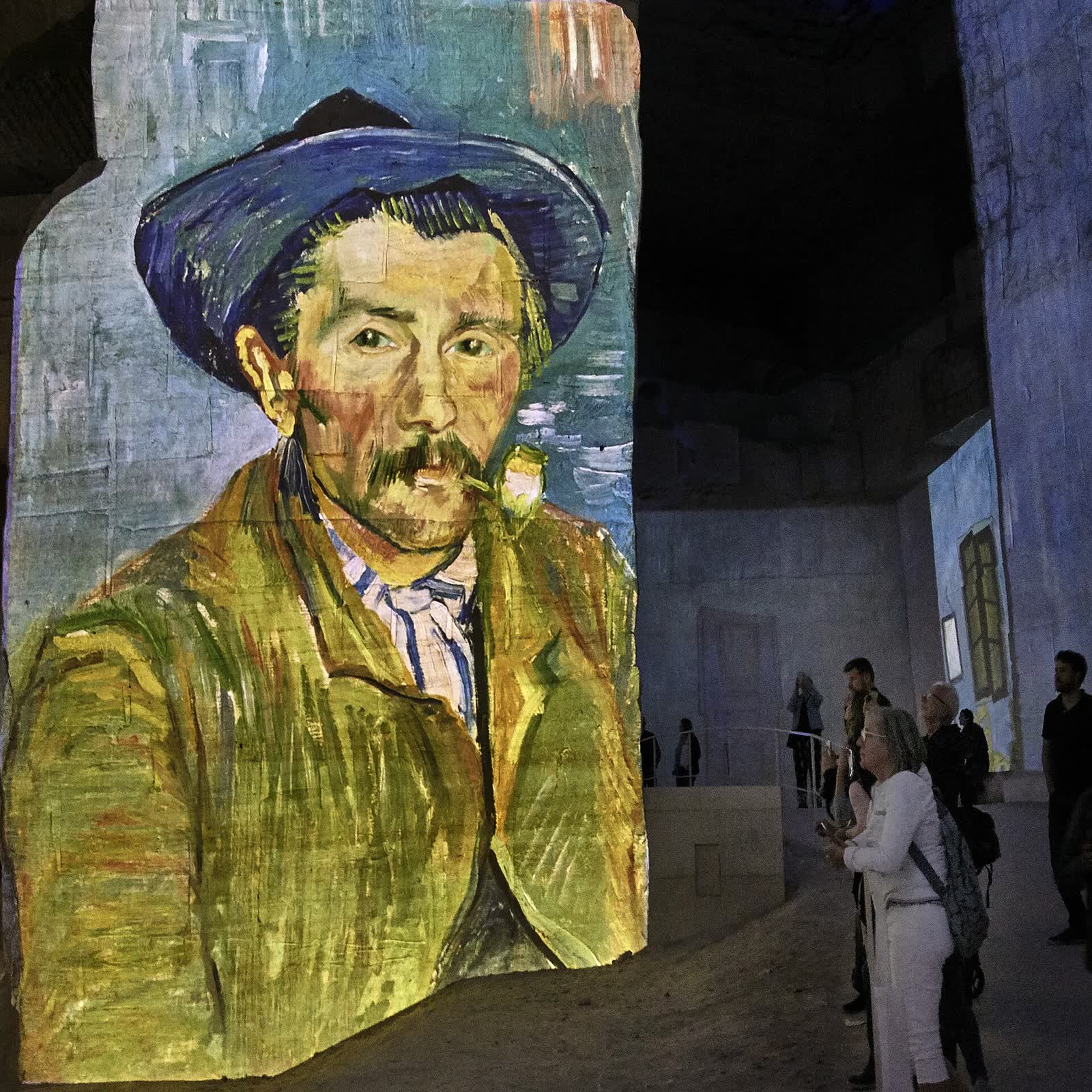
The projected version began in a quarry. At Les Baux-de-Provence in the 1970s, AEA Consulting’s Geoffrey Marsh writes, “nearly one hundred standard Kodak carousel slide projectors created a thirty-minute show.” Culturespaces took over the site in 2012 and renamed it the Carrières de Lumières.
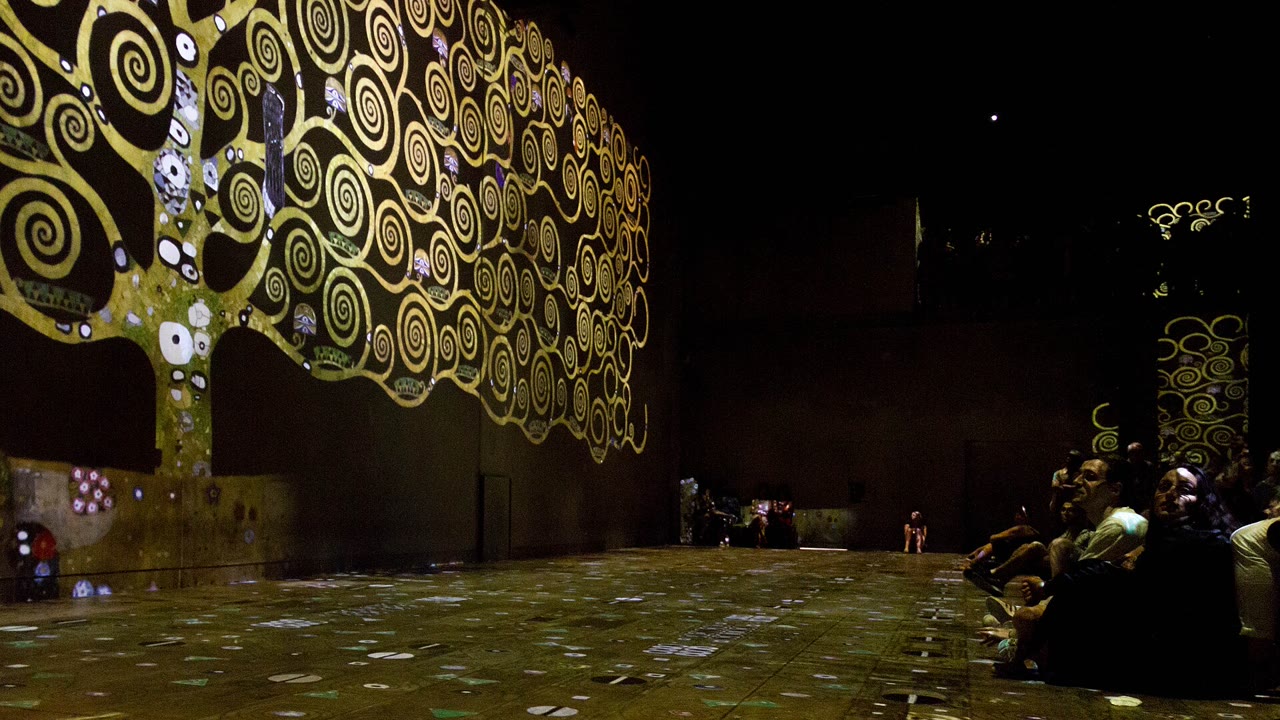
In Paris, Culturespaces rediscovered a foundry founded in 1835 and opened it as the Atelier des Lumières on April 13, 2018, with Klimt and Hundertwasser programmes. “In the first year, 1.2 million visitors” came, according to the Atelier des Lumières’ own history of the building. France.fr counts “140 video projectors and a spatial sound system” across “3,300 m2 of surfaces and walls up to 10 meters high.”
On June 21, 2018, teamLab Borderless opened in Tokyo, and it drew visitors “from over 160 countries and regions” before closing in 2022. Kusama’s rooms belong to the history of infinity mirror rooms, and Meow Wolf’s walk-in art to the history of Meow Wolf.
The Van Gogh rush, 2020-2023
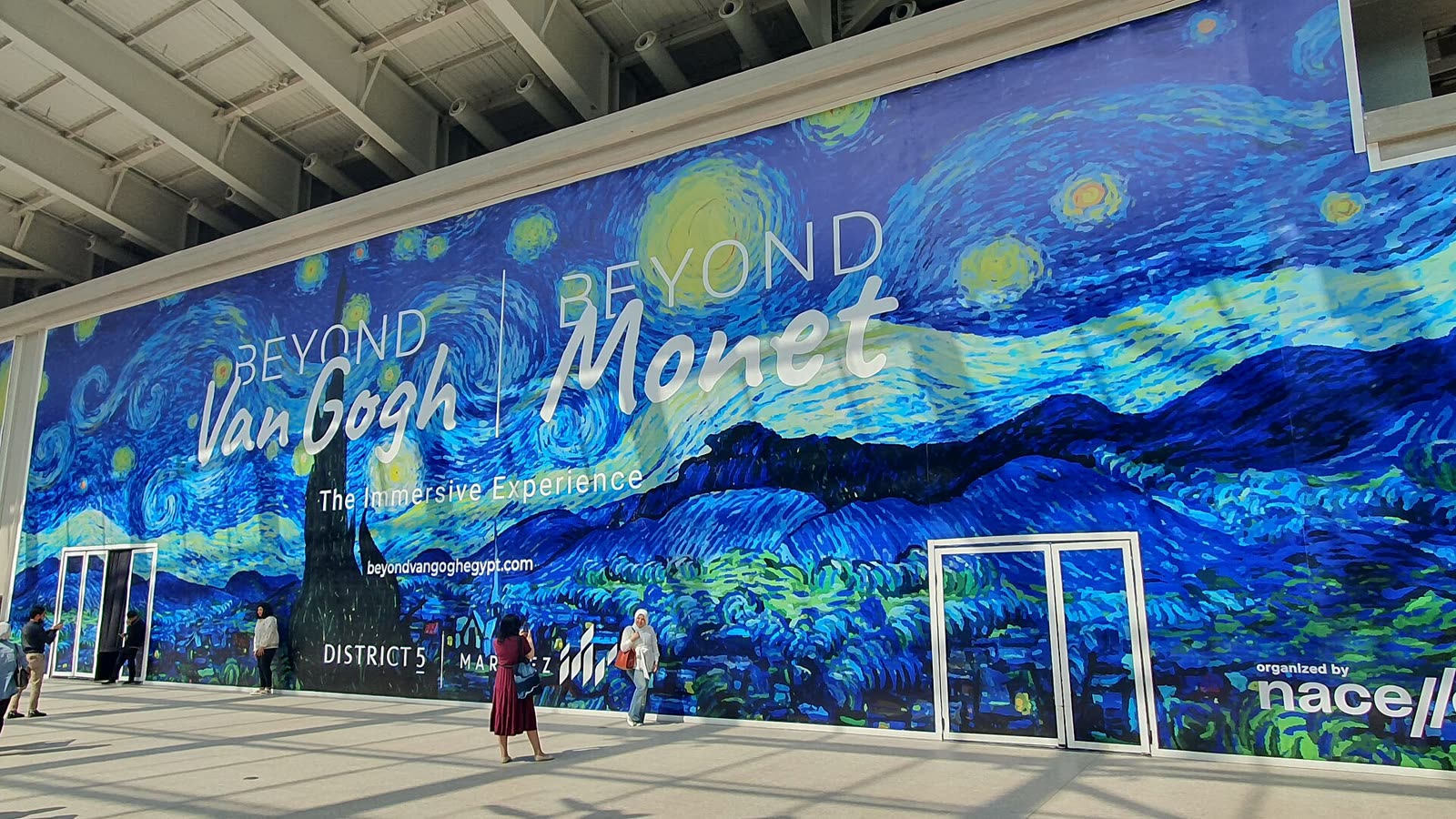
Immersive Van Gogh opened in Toronto in summer 2020 as what CBC Arts called “the world’s first drive-in art exhibition,” drawing about 200,000 visitors by December. Its producers, Svetlana Dvoretsky and Corey Ross of Lighthouse Immersive, were inspired by the Atelier des Lumières, where its creator, Massimiliano Siccardi, had been artist-in-residence.
Rivals followed fast: Imagine Van Gogh, Beyond Van Gogh, Van Gogh Alive and Van Gogh: The Immersive Experience, each a Van Gogh immersive experience of its own. By March 2021 the Better Business Bureau was warning New Yorkers about competing shows. Why so many? “This is happening only because Van Gogh is in the public domain,” Dvoretsky told CBC.
Then the boom faded. Lighthouse Immersive “filed for Chapter 15 bankruptcy on July 27” 2023, the Dallas Observer reported, and the Globe and Mail said it had “overspent on international growth after intense pandemic interest subsided.”
A Bay Area parallel: Antenna’s walk-in exhibitions

Antenna Theater, a Bay Area company better known for headphone shows, built walk-in exhibitions of its own, a parallel to this history rather than a source for it. Enola/Alone (1994) was “An interactive theater maze that put each visitor into the boots of a World War II bomber pilot,” as told in Enola/Alone, Antenna’s bomber-pilot maze.
Transforming Art (2004-2008) was “An interactive exhibition featuring sculptural works, anaglyph drawings (3-D), infinite mirrors, slotted sea creatures, furniture, and shadows.” One caption read: “Only one quarter of this object exists. The rest is mirror reflection.” The show is described in Transforming Art, Antenna’s experimental funhouse, and its mirrors have cousins in the history of mirror mazes.
From 2010, Magic Bus San Francisco, Antenna’s projection-lit tour, ran riders past “historic projections on retractable window screens,” which Robert Hurwitt said were made possible “by the invention of the micro video projector, which uses LEDs.” It sits among Walkmanology and Antenna’s other new theater forms. The difference from the projection halls is the visitor’s role: Antenna’s pieces asked people to act, not only to look.
The history of immersive exhibitions in eight dates
| Year | Event | Source |
|---|---|---|
| 1787 | Robert Barker patents the panorama | National Records of Scotland |
| 1881 | The Panorama of Scheveningen opens in The Hague, still in place | Panorama Mesdag |
| 1884 | Philippoteaux’s Gettysburg cyclorama comes to the United States | New Georgia Encyclopedia |
| 1887 | The Battle of Atlanta cyclorama debuts in Detroit | New Georgia Encyclopedia |
| 1970s | About 100 slide projectors light a quarry at Les Baux | AEA Consulting |
| 2018 | The Atelier des Lumières opens in Paris; teamLab Borderless in Tokyo | Atelier des Lumières; teamLab |
| 2020 | Immersive Van Gogh opens in Toronto as a drive-in | CBC Arts |
| 2023 | Lighthouse Immersive files for Chapter 15 protection | Dallas Observer |
Frequently asked questions
What is the difference between a panorama and a cyclorama?
They are the same form. Cyclorama was the name used in the United States for the building-sized circular battle paintings of the 1880s.
Why are there so many Van Gogh shows?
His paintings are in the public domain, as the producer Svetlana Dvoretsky told CBC Arts in 2021.
What happened to Lighthouse Immersive?
The company behind Immersive Van Gogh filed for Chapter 15 bankruptcy protection on July 27, 2023, after overspending on international growth.
Did Antenna Theater make immersive exhibitions?
Yes, as walk-through theatre: Enola/Alone (1994) and Transforming Art (2004-2008), and the projection-lit Magic Bus from 2010.