The History of the Living Theatre: Julian Beck, Judith Malina and Paradise Now
Few theatre companies have been shut by the fire department twice and the tax authorities once, then jailed abroad. The history of the Living Theatre is a story of two young New Yorkers, a string of lost buildings and a play that asked its audience to climb onto the stage and keep going into the street.
Quick answer
What is the Living Theatre?
The Living Theatre was founded in New York in 1947 by Judith Malina and Julian Beck as “a theater of poetry, a political theater”. Closed by the tax authorities in 1963, it toured Europe, created Paradise Now in 1968 and kept performing after Beck’s death in 1985 and Malina’s in 2015.
Two young New Yorkers and a theater of poetry (1943-1958)
“The history of The Living Theatre begins when Judith Malina and Julian Beck meet each other in 1943,” the company writes. “He was 18 and she was 17.” Malina had come to America from Kiel, Germany, as a small child, and trained under Erwin Piscator at the New School’s Dramatic Workshop; Beck had dropped out of Yale to paint.
Their aim was clear: “It would be a theater of poetry, a political theater, a theater different from Broadway and commercialism.” The company and the War Resisters League both date the founding to 1947, while a 2015 tribute on New York Theater gives 1948. The first plays were staged in the living room of their apartment at 789 West End Avenue.

In 1951 an inheritance of $6,000 let Beck rent the Cherry Lane Theatre on Commerce Street, until the fire department closed it in 1953. A loft at 100th Street and Broadway followed in 1954, and the fire department closed that too after a year.
14th Street: The Connection and The Brig (1959-1963)
In 1959 the company opened a theatre at 14th Street and Sixth Avenue, its home for five years. That July it staged Jack Gelber’s The Connection, about addicts waiting for a fix. “The actors mixed with the audience during intermission, begging for spare change,” and the play ran for over 600 performances. “The Living Theatre was on the map.”
Beck and Malina were “very committed pacifist anarchists.” The company says Malina spent a month in jail with Dorothy Day for refusing to take cover during an air raid drill in 1957; the War Resisters League’s notice on Judith Malina’s activism dates the arrest to 1955.
Kenneth Brown’s The Brig (1963) showed “twenty four hours in the life of a Marine prison brig”, and it drew the attention of politicians and the tax office. “The Living Theatre on 14th St. was shut down by the tax authorities in the fall of 1963.” The actors occupied the building for two days before police removed them.
Exile and collective creation (1964-1967)

After a trial and short jail terms in 1965, the company began “a four year nomadic existence in Europe.” Mysteries (1964) ended in a staging of the plague as Antonin Artaud described it, and the company calls Artaud’s Theater of Cruelty a significant influence.
Frankenstein (1965) was “a total theater production” on a three-storey frame of metal pipes, an idea explored in our guide to what total theatre means. Antigone (1967) used no set and street clothes and played over 200 times. More and more, the group made its work by collective creation.
Paradise Now (1968-1969)
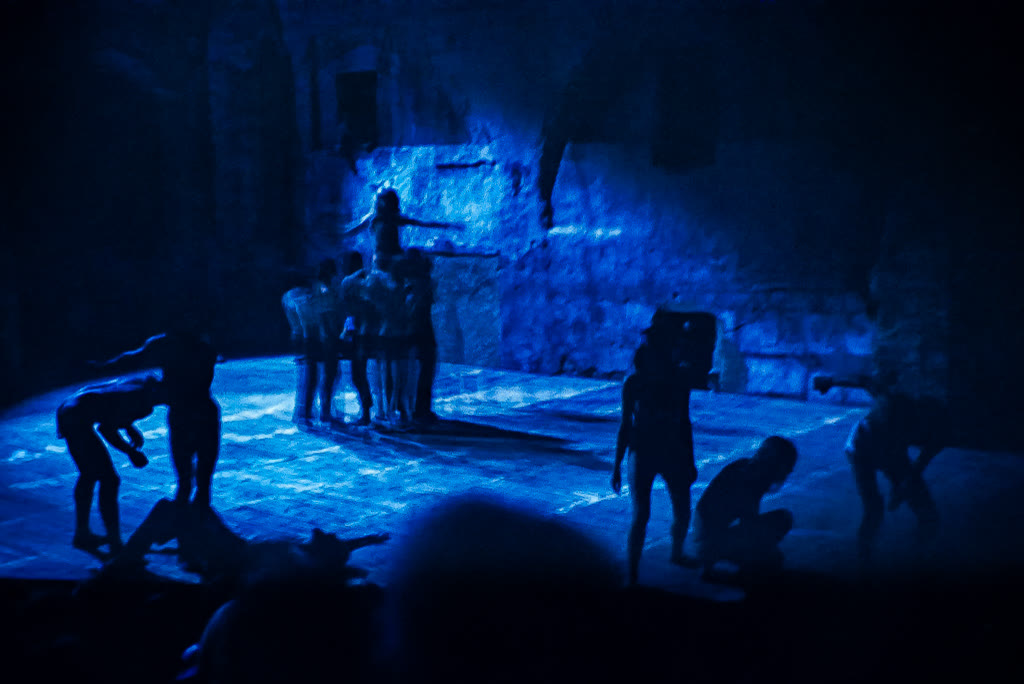
Paradise Now was “a four to five hour collective creation with a great deal of audience participation.” It climbed “an ideal ladder to paradise”, and between each rung “space was given for the audience to react/participate.” The result, the company says, was “mass participation, much nudity, utopian discourse, arguments, and sometimes arrests” because the last action took the theatre into the streets.
It opened at the Avignon Festival in July 1968; when the festival asked for a different play, the company left. A tour of the United States followed, from Yale “all the way to California”. John Tytell’s history, as quoted by Arthur Magazine, says Jim Morrison and Michael McClure took part in performances at the Nourse Auditorium in San Francisco.
The scholar James Penner writes that Paradise Now “dismantled ‘the fourth wall’ and encouraged the audience to take over the stage.” It also carried, he adds, “certain risks and dangers for the performers and the spectators.”
After the revolution (1970-1985)
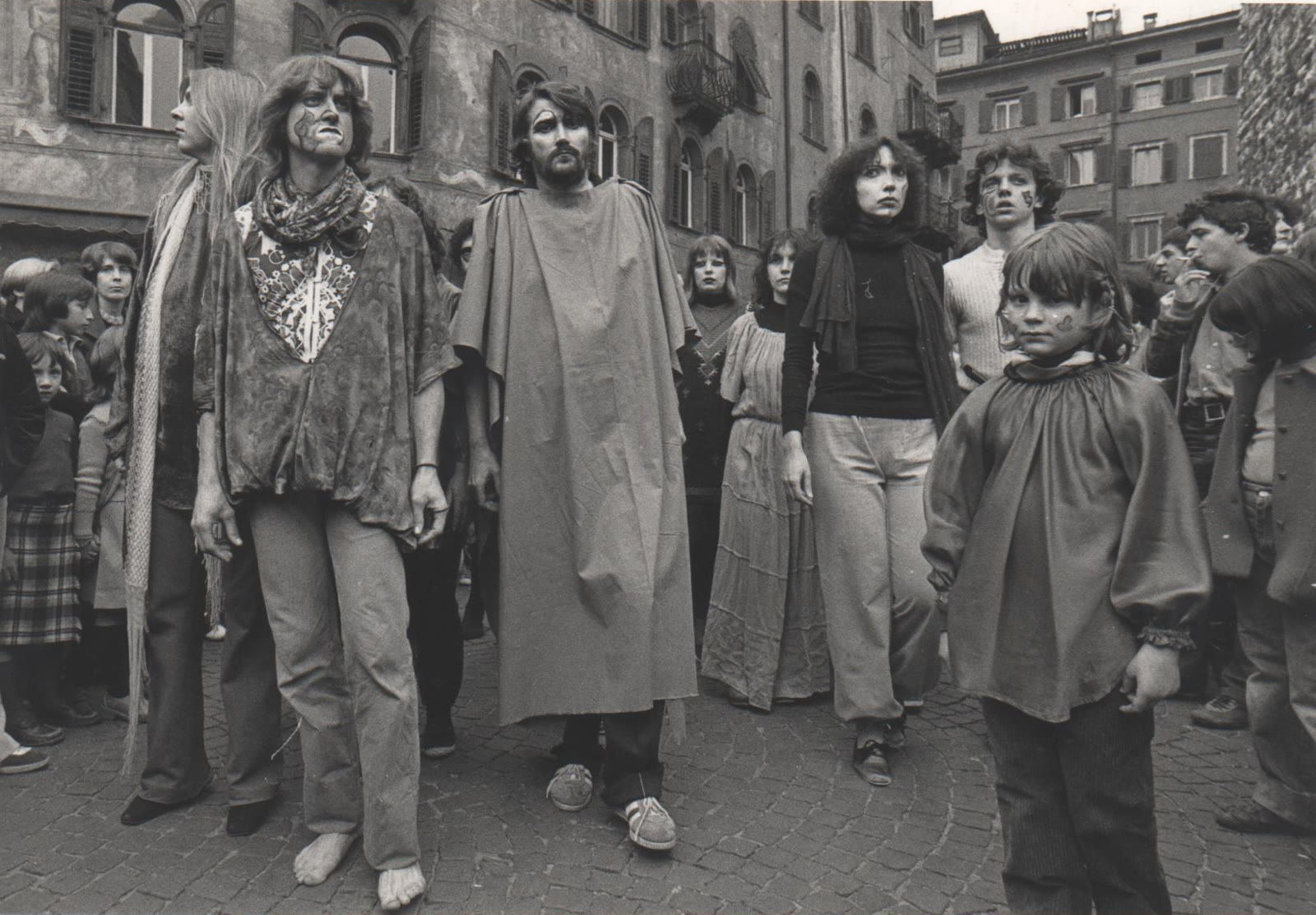
In 1970 “the 30 member group divided into four groups.” In Brazil in July 1971 the company was arrested, jailed for two months on a charge of “being in the presence of marijuana”, and deported. The Legacy of Cain cycle followed, with plays for schools, prisons and the street.
The Living left for Europe in 1975 for eight years, settling in Rome from 1977. Beck, ill with cancer, brought the company back to New York for a run in January 1984 and died in September 1985.
The Living after Beck (1985-today)

Hanon Reznikov became co-director in 1985. The company opened spaces on Third Street in 1989, in Rocchetta Ligure, Italy, in 1999 and on Clinton Street in 2007, where a revival of The Brig “ran for five months and won two Obie awards.” It left Clinton Street in March 2013.
Judith Malina died in April 2015, aged 88. The Living Theatre’s own detailed history says the company continues under board president Garrick Beck, the founders’ son, and artistic director Brad Burgess.
The history of the Living Theatre at a glance
| Year | Event |
|---|---|
| 1947 | Company founded (1948 in one tribute); first plays in their living room |
| 1959 | 14th Street theatre; The Connection |
| 1963 | The Brig; theatre shut by the tax authorities |
| 1964-1967 | Europe: Mysteries, Frankenstein, Antigone |
| 1968-1969 | Paradise Now at Avignon, then a US tour to California |
| 1985 | Beck dies; Reznikov becomes co-director |
| 2007-2013 | Clinton Street; The Brig revival wins two Obies |
| 2015 | Malina dies, aged 88 |
Two answers to the fourth wall: the Living and Antenna
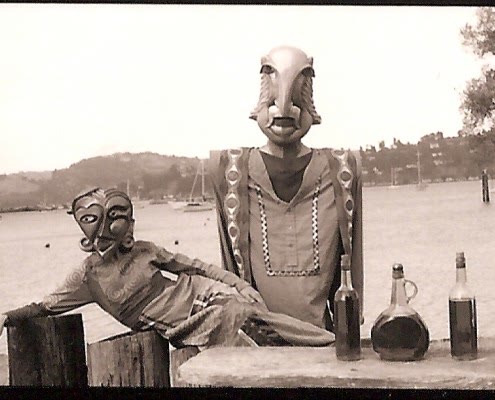
Antenna Theater also set out to break the wall between stage and seats, but by the opposite route. No source links the two companies; the contrast is the Journal’s. Where the Living handed the audience the stage, Chris Hardman handed each visitor a headset and a script, making the visitor what Antenna called the audient (see Antenna’s idea of the audient).
Steve Erickson wrote in Esquire in 1986 that the audience was “active only and utterly on Hardman’s terms.” Bernard Weiner of the San Francisco Chronicle wrote in 1987 that Hardman fitted audients with headsets because he was unwilling, or unsure how, to involve them “without losing control over the theatrical process.”
| Aspect | The Living Theatre (Paradise Now) | Antenna Theater (Walkman pieces) |
|---|---|---|
| Who acts | Performers and audience together | Each visitor, as the main actor |
| What guides them | Rungs of a ritual ladder, with open space between | A voice on tape |
| Who holds control | Shared and contested | The maker |
| Where it ends | In the street | At the exit of a maze |
Antenna’s Vacuum played the Performing Garage in Manhattan, the year after its premiere. For the wider argument see how immersive theater broke the fourth wall, and for siblings in this series, Survival Research Laboratories’ theatre of machines, Welfare State International’s community celebrations and Antenna Theater’s full production chronology.
Frequently asked questions
Who founded the Living Theatre?
Judith Malina and Julian Beck, who met in 1943 and founded the company in New York in 1947, by the company’s account.
What was Paradise Now?
A four to five hour collective creation built as a ladder of rituals, with space for the audience to take part between each rung. It opened at Avignon in July 1968.
Why was the Living Theatre closed in 1963?
The tax authorities shut the 14th Street theatre in the fall of 1963, after The Brig. The actors occupied it for two days.
Is the Living Theatre still active?
The company says it continues under board president Garrick Beck and artistic director Brad Burgess.