
What Is Total Theatre? Every Art on One Stage
Some theatre makers have never been content with actors and words. They want music, painting, architecture, light, film and recorded sound working together until the audience is surrounded. Ask what is total theatre and the trail leads back to an 1849 essay by Richard Wagner. This guide follows the idea through four landmarks and one Bay Area company’s stage shows.
Quick answer
What is total theatre?
Total theatre is theatre that combines every art (music, words, movement, design, light, film and recorded sound) into one experience that surrounds the audience. The idea comes from Richard Wagner’s total work of art of 1849 and runs through Erwin Piscator and Walter Gropius, Antonin Artaud and Robert Wilson.
Wagner and the total work of art

“Gesamtkunstwerk is a German term which translates into the English ‘total work of art.’” In TheCollector’s definition it means “an immersive art experience in which various forms of art and/or design made by different artists come together to form a single, unified whole.”
“The term was first popularized by the German composer Richard Wagner in the 19th century.” In The Artwork of the Future (1849) he argued for a work in which “no one rich faculty of the separate arts will remain unused.” His Ring cycle, “a series of four operas,” followed in 1876, staged in the theatre he built at Bayreuth.
For Wagner, the Gesamtkunstwerk in theatre meant music drama as the meeting point of every art. Later, Walter Gropius “embraced the concept of a Gesamtkunstwerk as the entire ethos behind his educational establishment,” the Bauhaus.
Piscator and Gropius: a theatre built to surround the audience

The Berlin director Erwin Piscator wanted the machinery for a purpose. According to CanonBase, a European theatre-technology archive, “Piscator proposed that the use of the technical and expressive innovations of the theatrical avant-garde should not be an end in itself, but a means to achieve a social and political end.” His 1925 production Trotz Allem was “a gigantic montage of authentic speeches, writings, press cuttings, proclamations, photographs, films.”
Piscator commissioned Gropius in 1926, and the design is dated 1927. “The Total Theatre was intended to finally achieve the modern theatre’s quest to invent new technical and spatial means to introduce the spectator into the dramatic action, to a greater extent than ever before.” Corridors behind the audience could carry action or projected images, and “The dome of the hall itself was to contribute to the creation of an enveloping atmosphere.”
It was never realized. Harvard Art Museums holds the 1927 Total Theater drawing for Piscator, a gift of Walter Gropius. Bertolt Brecht was cooler, writing that Piscator “found it easier to achieve a critical approach to great themes through ingenious and imposing stage effects than through the work of the actor.”
Artaud: spectacle before text
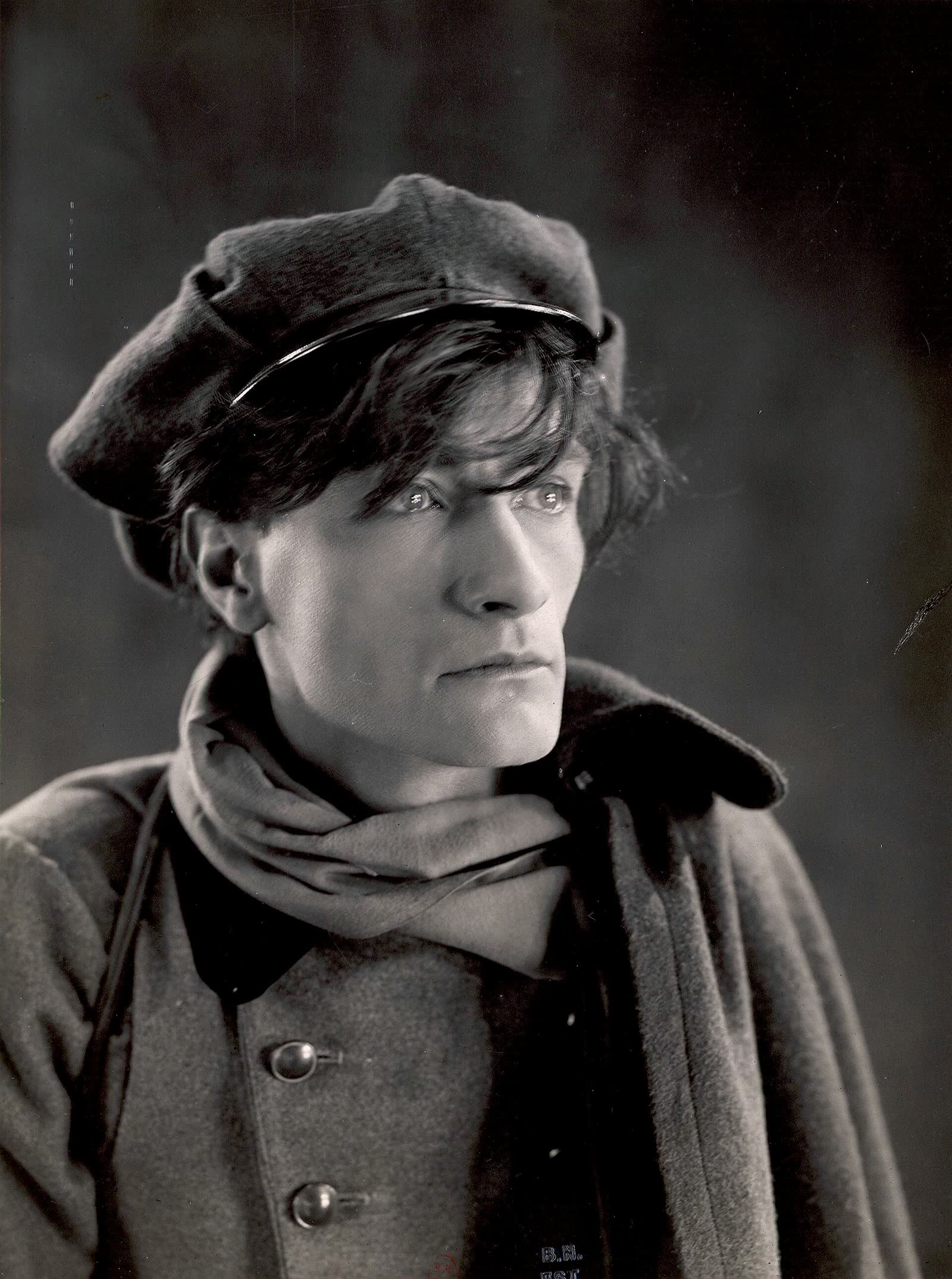
Antonin Artaud pushed from another side. In Pericles Lewis’s account of Artaud for Yale’s Modernism Lab, Artaud “announced that ‘we intend to base the theater upon spectacle before everything else.’” “Emphasizing loud sounds and bright lights, Artaud wanted to ‘abolish the stage and auditorium,’ and have spectators sit in the middle of a large room, while watching the action around them.”
Actors would be “passive and neutral,” and “their faces would be replaced by large puppets and masks.” Lewis calls the result total theater, and sums up the contrast: “For Brecht, all is detachment and reason; for Artaud, all is spectacle and catharsis.” Part of the spark was “the trance-inducing Balinese ritual dance, which he first saw in 1931.”
Robert Wilson and the theatre of images

Robert Wilson, born in Waco, Texas, made stage works that “unconventionally integrate a wide variety of artistic media, including dance, movement, lighting, sculpture, music and text.” Einstein on the Beach, with music by Philip Glass, was produced at the Venice Biennale in 1976. When Wilson died in 2025, the Biennale mourned “the great theatre director, author and total artist Bob Wilson.”
| Year | Who | Idea or work |
|---|---|---|
| 1849 | Richard Wagner | The Artwork of the Future: no art left unused |
| 1926 to 1927 | Erwin Piscator and Walter Gropius | The Total Theatre, a hall to bring the spectator into the action; never built |
| 1930s | Antonin Artaud | Spectacle first: sound, light, masks and puppets around a central audience |
| 1976 | Robert Wilson and Philip Glass | Einstein on the Beach: dance, movement, light, sculpture, music, text |
| 1981 to 1991 | Antenna Theater | Vacuum, Russia, Caveat Emptor: masks, taped interview voices, projections, puppets, sound collage |
Total theatre examples from the Bay Area: Antenna’s stage shows
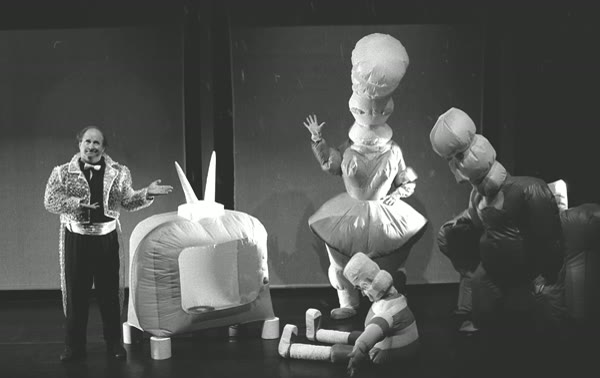
Antenna Theater is known for Walkman walk-throughs, but its seated stage shows are the case here. No source has Chris Hardman using the term; the critics’ words do the work. Vacuum, the masked play built from interviews (1981), was “A blend of dance, performance sculpture, taped narrative and original music.”
Russia (1985) “featured sliding projections, sound effects, masked actors, and audio collages.” Bernard Weiner of the San Francisco Chronicle called it “a simple scaffolding upon which Hardman hangs all sorts of visual, aural and verbal delights.” One scene ended with “an atomic explosion that sends abstract reds, blues, oranges all across the three rear panels.”
In Artweek, Will Torphy compared the masks to Noh: “we are strangely distanced intellectually, yet emotionally drawn toward the magic of the nuances.” The tradition behind them is explained in how mask theatre works.
Caveat Emptor (1991) went furthest. The Marin Independent Journal headlined its review “A play for all senses,” and Scott Rosenberg of the San Francisco Examiner listed “slide projections, puppets, masks, sculptures and live actors who mostly lip-sync to pre-record-ed tapes.” He compared the stage to “a segment of the ‘spaceship’ design from Robert Wilson’s ‘Einstein on the Beach.’” The production has its own post: Caveat Emptor, Antenna’s 1991 stage pageant about security.
| Element | What the critics saw in Caveat Emptor |
|---|---|
| Masks and puppets | Puppets, masks and sculptures on a vast set designed with Ronald M. Davis |
| Projection | Slide projections |
| Sound | A sound collage by David Torgersen, with music by Roy Marcom |
| Light | Jim Schelstrate’s lighting cutting tunnels and arcs through the murk |
| Actors | Live actors who mostly lip-sync to pre-recorded tapes |
| Structure | Stories told in snippets, in a channel-changing format |
Hardman’s 1983 essay on the Walkman even opens with a Wagner memory: “I was in rapture combining Wagner with Koln’s cathedral and baroque trumpets with Parisian streets.”
Total theatre today

Gropius wanted to bring the spectator into the dramatic action; walk-through environments now put the visitor inside it. Antenna’s own Euphor!um (2000 to 2003) offered “digital audio effects, infinite mirrors, and a few Coney Island funhouse tricks.”
The nearest relative is the theatre installation, where the room becomes the play. At the other extreme sits forum theatre, which strips the stage back to a debate. For how far the idea has travelled from the proscenium, see how immersive theater differs from a traditional stage.
Frequently asked questions
What does Gesamtkunstwerk mean?
It is German for total work of art. Richard Wagner made the term famous in 1849.
What was Gropius’s Total Theatre?
A 1927 design for the director Erwin Piscator, meant to bring the spectator into the action with projection spaces around the audience. It was never built, and Harvard Art Museums holds drawings of it.
Was Artaud a total theatre artist?
His theatre called for loud sound, bright light, masks and puppets around a central audience, and Yale’s Modernism Lab describes it as total theater.
Is Robert Wilson’s work total theatre?
The Venice Biennale called him a total artist, and his stage works combined dance, movement, lighting, sculpture, music and text.
For Antenna’s better-known inventions, see Walkmanology and Antenna’s other new theater forms.