Theater Without Actors: Who Performs When No One Is on Stage?
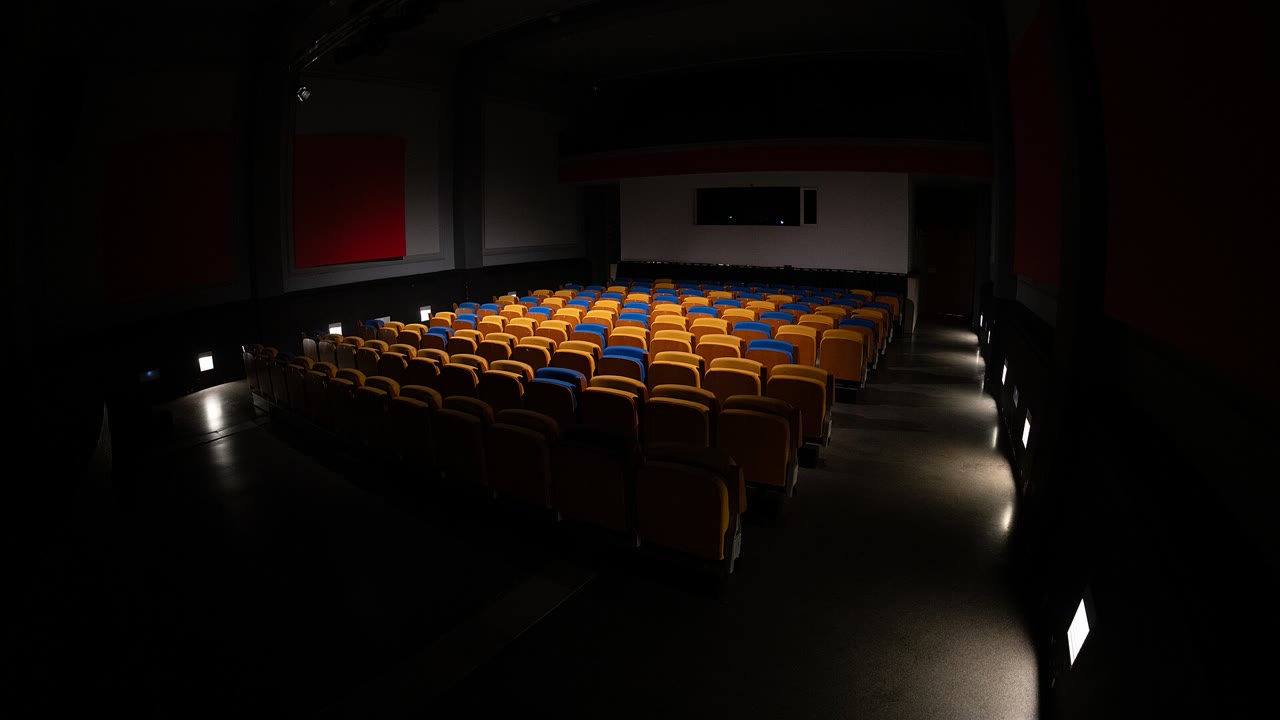
Theater without actors sounds like a contradiction. Peter Brook’s well-known baseline in The Empty Space (1968) is that “any empty space in which one actor walks as someone else watched could be a theatre.” For more than a century, makers have tried to take that actor away. What they put in the gap says a lot about theater.
Quick answer
What is theater without actors?
It is performance in which no live performer carries the show. A recorded or synthetic voice, a machine, objects, light and sound, or the audience itself takes the actor’s place. Examples include Beckett’s Breath (1969), Heiner Goebbels’s Stifters Dinge (2007) and Antenna Theater’s Walkman pieces, where each listener became the lead.
Can there be theater without actors?

In March 2019 the critic Matt Trueman, writing in The Guardian, looked at two London shows that had no performers at all. Enda Walsh’s Rooms at the Barbican played recorded voices in five rooms. Dismantle This Room put an escape room on the Royal Court’s main stage, where 15 audience members did the work.
Walsh himself hedged about Rooms: “I wouldn’t classify it as theatre, but I don’t know exactly what it is.” Most makers answer yes, as long as something else carries the show.
Five things that replace the actor
Sorted by what fills the gap, the answers fall into five types.

| Replacement | How it works | Example | Year |
|---|---|---|---|
| A figure or machine | An inanimate figure or an animatronic takes the actor’s place | Craig’s über-marionette (theory); Rimini Protokoll’s Uncanny Valley | 1908; 2018 |
| Objects, light and sound | The stage itself performs | Beckett’s Breath; Goebbels’s Stifters Dinge | 1969; 2007 |
| A recorded or synthetic voice | Listeners follow a voice through space | Rimini Protokoll’s Remote X; Enda Walsh’s Rooms; Punchdrunk’s Viola’s Room | 2013; 2019; 2025 |
| Non-actors (“experts”) | Real people bring their own expertise | Rimini Protokoll’s experts of the everyday | From 2000 |
| The audience | Visitors become the cast, following tapes or devices | Antenna’s audient; Blast Theory’s Rider Spoke; Dismantle This Room | 1981-1985; 2007; 2019 |
A short history of theatre without performers
1908: Craig wants the actor gone

The designer Edward Gordon Craig made the case in a 1908 essay, “The Actor and the Über-Marionette,” reprinted in his 1911 book On the Art of the Theatre. “The actor must go, and in his place comes the inanimate figure, the über-marionette we may call him, until he has won for himself a better name.”
His target was realism: “Do away with the actor, and you do away with the means by which a debased stage-realism is produced and flourishes.” Craig’s über-marionette stayed mostly theory, but the idea of a figure in the actor’s place never went away.
1969: Beckett’s Breath

Samuel Beckett removed the figure too. The Irish Playography entry sums up Breath in two sentences: “Breath lasts less than a minute. On a set full of rubbish, a person cries out, then breathes in again.” It is a stage piece of under a minute with no performers on view, only rubbish, light and recorded breath.
2007: Goebbels’s “no-man show”
The composer Heiner Goebbels made the best-known modern example. Stifters Dinge was first staged in 2007 at Théâtre Vidy-Lausanne, then in London in 2008, and Artangel’s page for Stifters Dinge calls it “a composition for five pianos with no pianists; a performance without performers.”
Goebbels’s own billing adds “a play without actors, a performance without artists, a kind of ‘no-man show’.” The Village Voice, reviewing the 2009 run at the Park Avenue Armory, counted “70 minutes of music, light, water, and prerecorded voices without a single live performer (save a few stagehands).”
Experts, robots and synthetic voices: Rimini Protokoll
Helgard Haug, Stefan Kaegi and Daniel Wetzel founded Rimini Protokoll in 2000. A profile of the company puts its method simply: “The performers in their works are non-actors, but rather experts.” In Remote X (Berlin, 2013), a group of 50 people walked through a city in headphones, steered by a synthetic voice of the kind GPS navigators use.
Then the company replaced a writer with a machine. For Rimini Protokoll’s Uncanny Valley, with its animatronic author, “Thomas Melle allowed an animatronic double of himself to be made. This humanoid takes the author’s place.”
When the audience becomes the cast
Antenna’s audient and “audient = actor”
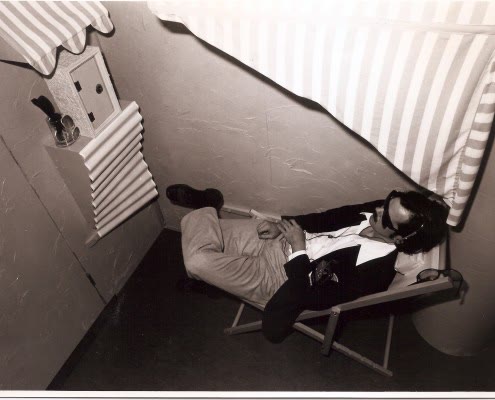
Antenna Theater in Sausalito chose a different replacement: the visitor. The archive’s account of Antenna’s idea of the audient says that “the audience would become the main actor in the center of the play.” With headsets on, audients could hear separate stories from each other. “They become actors,” the page says.
In a 1983 essay in The Drama Review, Chris Hardman wrote it as a formula: “This equation, audient = actor, requires some new language.” The upside was plain: “You can’t forget your lines, they’re all on the tape; you’re not responsible for your performance, you’re just doing a job.”
His High School (1981) came close to an empty stage. Audients walked “a mile-long white line” at night “while hearing lockers slamming, textbooks dropping and students racing by,” while “seeing almost no one.” For the device side, see the longer history of headphone theater and how binaural audio drama puts a voice inside your head.
Audients performing for audients
Pink Prom (1982) was a prom danced by students following recorded tapes, which Hardman called “our first synchronized, Walkman-activated performers.” In Fairplay (1985), some audients ended up dancing as go-go dancers for other audients who were playing sailors on leave.
A 1985 profile by Robert Hurwitt described the form as one in which audients “wander through fabricated environments and become actors in the drama they hear unfolding on tape.”
Blast Theory and the city as stage
The British group Blast Theory made the audience supply the content. Rider Spoke was “first shown at the Barbican in London in October 2007.” Riders cycled alone with a smartphone on the handlebars, recorded answers in hiding places and found strangers’ recordings, an early chapter in the history of stories that know where their listener is.
Was the actor ever really gone?
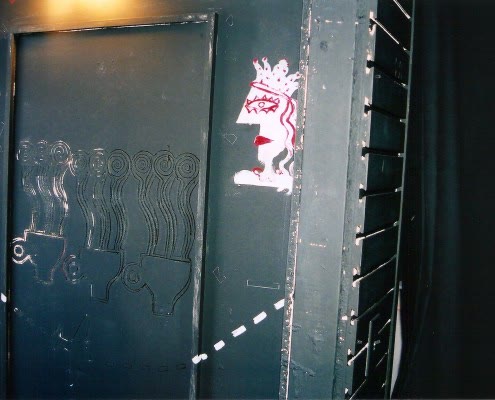
Not always. Antenna’s mazes reduced the actor rather than always removing one. In Amnesia and its masked actors, “Masked actors assisted the ‘audient’ through the swirl of events.” Other pieces came much closer to no cast at all.
| Work | Year | Who performed | Live actors? |
|---|---|---|---|
| High School | 1981 | The audient, guided by a voice on tape | Hardman: “seeing almost no one”; later versions list student actors and puppets |
| Pink Prom | 1982 | Students following synchronized Walkman tapes | The participants were the performers |
| Artery | 1982-1985 | One audient as the hero | Critics: “a theater without a cast” |
| Amnesia | 1983-1984 | The audient as a patient | Yes, masked actors |
| Fairplay | 1985 | Audients performing for other audients | Not clear from the sources |
| Sands of Time | 1998-2002 | A recorded voice and sculpted sand | None mentioned in the sources |
Artery, the Walkman maze of 1982 to 1985, drew the strongest claims. San Francisco Magazine wrote that “the viewer is the sole performer,” and The Mexico City News called it “a theater without a cast.” Our guide to how a one-person maze guided each visitor covers the mechanics, and Enola Alone, the 1994 bomber pilot maze at the Presidio, shows where the form went next.
At the far end sits Sands of Time, a beach walk with only a recorded voice, where visitors hiked along the beach “viewing the sculpted sand while hearing the story of the universe.”
Frequently asked questions
Can you have theater without actors?
Yes. Since Craig wrote in 1908 that the actor must go, makers have replaced performers with objects, recorded voices, machines, non-actor experts and the audience itself.
What was Beckett’s play with no actors?
Breath (1969), a stage piece of under a minute set on a stage full of rubbish, with light and recorded breath in place of performers.
What is an audient?
It is Antenna Theater’s word for an audience member who becomes the main actor, wearing headphones and following a soundtrack through a set.
For the wider picture, see Walkmanology and Antenna’s other new theater forms.