What Is a Theatre Installation? When the Room Becomes the Play
Walk into a room built, down to the last object, to tell you a story, and often nobody steps forward to perform it. The room does the work. That is the short answer to what is a theatre installation, a form that sits between the gallery and the stage.
Quick answer
What is a theatre installation?
A theatre installation is a built room, set or series of spaces that visitors walk into and explore, where the space, objects and sound do the work of a cast and a stage. It sits between installation art and theatre: Ilya Kabakov’s “total installation” made the viewer the main actor.
Theatre installation, defined

The announcement for Anne Ring Petersen’s book Installation Art: Between Image and Stage puts the family tree in one line: “installation art is influenced by visual arts and performance theatre.” Installations, it adds, “are characterised by being formed as spaces or spatial scenographies that convey meaning and sensory experience through their imagery.” A theatre installation is the branch that leans hardest toward the stage.
The art historian Claire Bishop put the visitor at the centre. As Derval Tubridy quotes her, installation art “addresses the viewer directly as a literal presence in the space,” and that “insistence on the literal presence of the viewer is arguably the key characteristic of installation art.” When the room is made mostly of sound, it becomes a sound installation, the gallery’s listening room.
| Aspect | Play in a theatre | Installation art | Theatre installation |
|---|---|---|---|
| Where you are | Seated, facing a stage | Inside the work, a literal presence in the space | Inside a built set or rooms, walking a route |
| Who performs | Actors | Objects, space, light, sound | Space, objects and sound; sometimes actors, often none |
| Story | Told by the cast | Implied by the objects | A directed route, with the artist as director |
| Example | Any proscenium play | The Man Who Flew into Space from His Apartment (1985) | Etiquette of the Undercaste (1988); Punchdrunk’s mask shows (from 2000) |
Where the idea comes from
Kabakov’s total installation

The idea got its sharpest name from Ilya Kabakov (born 1933). In On the Total Installation (1995) he wrote: “The main actor in the total installation, the main center toward which everything is addressed, for which everything is intended, is the viewer.” What made it total was “the required inclusion of surrounding space in the installation,” a different sense of the word from total theatre on the stage.
Kabakov cast the artist as the “director” of a “well-structured dramatic play.” Unlike a theatregoer, the visitor “does not sit still, but moves freely around inside of it, finds newer and newer points of examination.” Everything, he wrote, “should remind him of the stage in a theatre, when the viewer goes up onto it during the intermission.”
His best-known example is The Man Who Flew into Space from His Apartment, in the Kabakovs’ own catalogue, first realized in Kabakov’s Moscow studio in the mid-1980s (1985, according to the artists’ catalogue). “The small room (1.4 x 3.0 x 2.5 meters) is a spectacle of total devastation,” with “an enormous hole in the ceiling,” and “you can only look into the room through the cracks.”
Is it art or theatre?

Not everyone welcomes the comparison. Wilder writes that installations “are described as ‘staged’ precisely because they utilise overt scenographic strategies.” The philosopher Juliane Rebentisch took the opposite view and “disavows the distinction between art and theatre, positing that ‘there is no art that is not theatrical’.”
Theatre makers who build installations
Punchdrunk’s masks and rooms

From the theatre side, the best-known builder is Punchdrunk. “Founded in 2000 by Felix Barrett, Punchdrunk has pioneered a game-changing form of theatre which places the audience at the very heart of the action,” says Punchdrunk’s own account of the company, known for its masked shows. Barrett has recalled that “When we first started nobody used the word ‘immersive’,” and “We were a ‘site-specific’ theatre company.” That older vocabulary is unpacked in site-responsive theatre and its cousins.
In London, The Drowned Man (2013) filled “200,000 sq ft. of labyrinth of spaces” with “interactive environments filled with intricately detailed installations, smells, sounds, and even tastes.” Sleep No More, the company’s New York show, closed in January 2025, and how immersive theater differs from a traditional stage tells that story.
Schlingensief’s stage installation in Venice

The German director Christoph Schlingensief died in August 2010. The following year, the German Pavilion at the Venice Biennale showed the stage installation of his Fluxus oratorio, A Church of Fear vs. the Alien Within. A set made for performance became a theatrical installation in a national pavilion.
A Bay Area case: Antenna’s interactive performance installation
Etiquette of the Undercaste, 1988
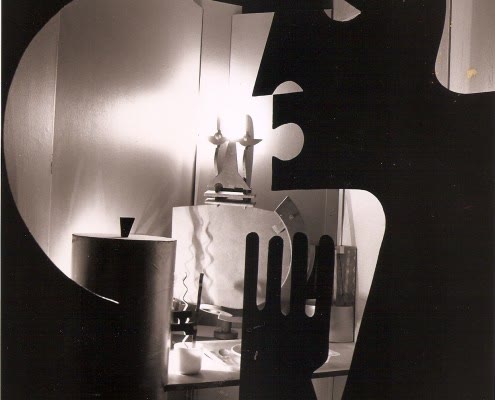
In 1988 Antenna Theater opened a theater installation that its own pages called “An interactive performance installation that leads visitors through a maze of thirteen rooms.” In the San Francisco Chronicle, Steven Winn wrote that “visitors to Antenna Theater’s latest ‘interactive installation’ are equipped with a Sony Walkman and headset.” The full story is in Etiquette of the Undercaste, Antenna’s 13-room maze.
Critics struggled to file it. In the London Times, Paul Moor described “an architectural construct (designed by Ronald M. Davis) with an environment appropriate to each episode,” in which “you hear a stereophonic montage of voices.” When the Smithsonian presented it in 1992, the Philadelphia Inquirer wrote that its format “bridges the divide between typical museum exhibits and theater.”
Hardman’s reason: because it is an installation
Chris Hardman, who made the piece, gave a practical definition of the form. “We’re putting the visitors in the center of the scene, inside the picture,” he told the New York Times in 1992.
To the Inquirer he explained why the rooms were not realistic: “And we felt that realism would be in a sense cloying and not achievable because it is an installation. It’s an artistic conceit.”
The Grid, Making Waves, Euphorium and after
Antenna kept using the word. Its pages called The Grid (1989, at the Wexner Center) an audio installation and Making Waves (1994) a mix of theater and installation art, while Euphorium (2000 to 2003) was “Part performance, part art installation.” By 1994 Winn could credit the company with “12 years of developing these sorts of installations in both indoor and outdoor locations.”
Later, Hardman’s gallery installation Transforming Art (2004 to 2008) was “An interactive exhibition featuring sculptural works, anaglyph drawings (3-D), infinite mirrors.” At the smallest scale, shows built for one visitor at a time push the same idea further.
Theatre installation art in six dates
| Year | Work | Maker | Place |
|---|---|---|---|
| 1938 | Coal sacks over the Surrealist exhibition | Marcel Duchamp | Galerie des Beaux-Arts, Paris |
| 1985 | The Man Who Flew into Space from His Apartment | Ilya Kabakov | Moscow studio; Centre Pompidou since 1989 |
| 1988 | Etiquette of the Undercaste | Chris Hardman, Antenna Theater | San Francisco; the Smithsonian in 1992 |
| 2000 | Punchdrunk founded; its mask shows | Felix Barrett | London |
| 2011 | Stage installation of A Church of Fear vs. the Alien Within | Christoph Schlingensief | German Pavilion, Venice Biennale |
| 2013 | The Drowned Man | Punchdrunk | London, 200,000 sq ft |
Frequently asked questions
What is a total installation?
It is Ilya Kabakov’s term for an installation that takes in the whole surrounding space and makes the viewer its main actor.
Is installation art theatre?
Critics disagree. Kabakov held that installation also works as theatre, and the philosopher Juliane Rebentisch argued that there is no art that is not theatrical.
Is immersive theatre an installation?
Often in part. Punchdrunk’s The Drowned Man was filled with detailed installations, smells, sounds and tastes, but it also had performers, and the company first called itself site-specific.
Can a theatre installation have no actors?
Yes. Antenna’s Etiquette of the Undercaste led visitors through thirteen rooms with a Walkman soundtrack, and Chris Hardman said realism was not achievable because it was an installation.
For the wider picture, see Walkmanology and Antenna’s other new theater forms and what Antenna meant by an audient.